The existence and necessity of sales is a middle finger to the classical economic assumptions of perfect information and rational buyers.
The stereotype of the sly salesperson using devilish tricks to bypass your rational faculties and hypnotise you into a decision you would not have made upon reflection is partly true. However, less appreciated is that much of the salesman’s role is to tactfully expose you as holding contradictory or counter-productive beliefs, and win the sale by dissuading you of the genuinely irrational reasons holding you back.
The dance of the buyer and the seller is one that involves an escalating back-and-forth of lying to each other, making fallacious arguments, and exposing the lies and fallacies of the other party, until one person’s frame remains. Whoever wins this exchange decides the outcome of the sale.
Surprisingly, the first lie is customarily told by the buyer, not the seller.
The dance begins when the salesman asks for the sale, and the prospect politely replies…
“That sounds great, let me think about it and get back to you”
One of the central tensions in a sales conversation is the buyer’s unwillingness to say “no” outright. Telling a friendly person who has given you a compelling set of reasons you should buy a thing, “no”, because you’re afraid of them scamming you, or unable to afford it, or have a vague sense of hesitation you can’t articulate, tends to make people sheepish.
If you haven’t been on the seller’s side of the conversation, this being a lie may strike you as an unfair assumption. Of course they need to think about it - thinking about it is perfectly reasonable.
However:
P(they buy it next week | “oh yeah, sounds great lemme get back to you”)
Is tiny - close to 1% in practice.
And so, the lie is twofold:
- “that sounds great” (implying likely eventual acceptance - a conscious lie),
- “let me think about it” (implying they will actually do that, which they won’t - often a lie to themselves).
It’s much easier to pretend to be eager, get off the call, and “make the decision later”. This later decision tends to come in the form of buying from a competitor who was a bit better at not letting you get off the call to have a think.
When confronted with this opening lie, a poor salesman says: “Sounds good, I’ve just sent the details to your email, looking forward to hearing from you.”
A mediocre salesman says: “Certainly, let’s pencil in a time for a quick chat tomorrow once you’ve had a chance to review it all - does morning or afternoon work better?”
A good salesman knows both of those guys have lost themselves a customer.
The way to reliably sell to a customer who tells you “oh yeah, definitely, I just need to think it over” is to disarm the lie and tease out the underlying concern the lie conceals.
You do this by politely acknowledging their desire to leave, ignoring it completely, and continuing the conversation like so:
“Yeah that’s no problem at all, I totally respect that” (lie)
“Before you go and think about it though, can I ask, do you feel what we’ve gone over today can get you to XYZ result?”
This is merely a diversion and a means to reaffirm their confidence - “it will work” is much more psychologically effective when spoken by the buyer rather than the seller
Oh yes, definitely. It sounds fantastic. (often a lie)
“And what’s the key for you that makes you feel [our thing] can get you to [result]?”
(again, to get them to double down and sell it to themselves)
Because of X, Y and Z
“Ah, interesting (lie), that makes sense. So, can I ask, when you do go and think this over, what is it that’s coming up for you that makes you feel you want to do that (think about it)? Just to see if I can help with that” (lie - the goal is simply to advance the sale).
Ideally, the seller will hear: “well, it’s a lot of money” / “I’m afraid it won’t work” / “I can’t start until I get the next shipment”
If not, it’ll be some version of “Just because I want to think about it” / “I always think about things like this before committing”, or yet another deflection: “well, I need to speak to my partner before pulling the trigger”.
In which case, you again “totally respect that”, gently pull them into the same loop, distracting them with tangential questions to defuse the resistance and remind them of the value, and then ask them again in a slightly different way.
…Just before you go, I wanted to ask, if you do feel this is the answer for you, and I know you mentioned having XYZ problem, what are the things that come up for you that you will focus on when you’re thinking it over?
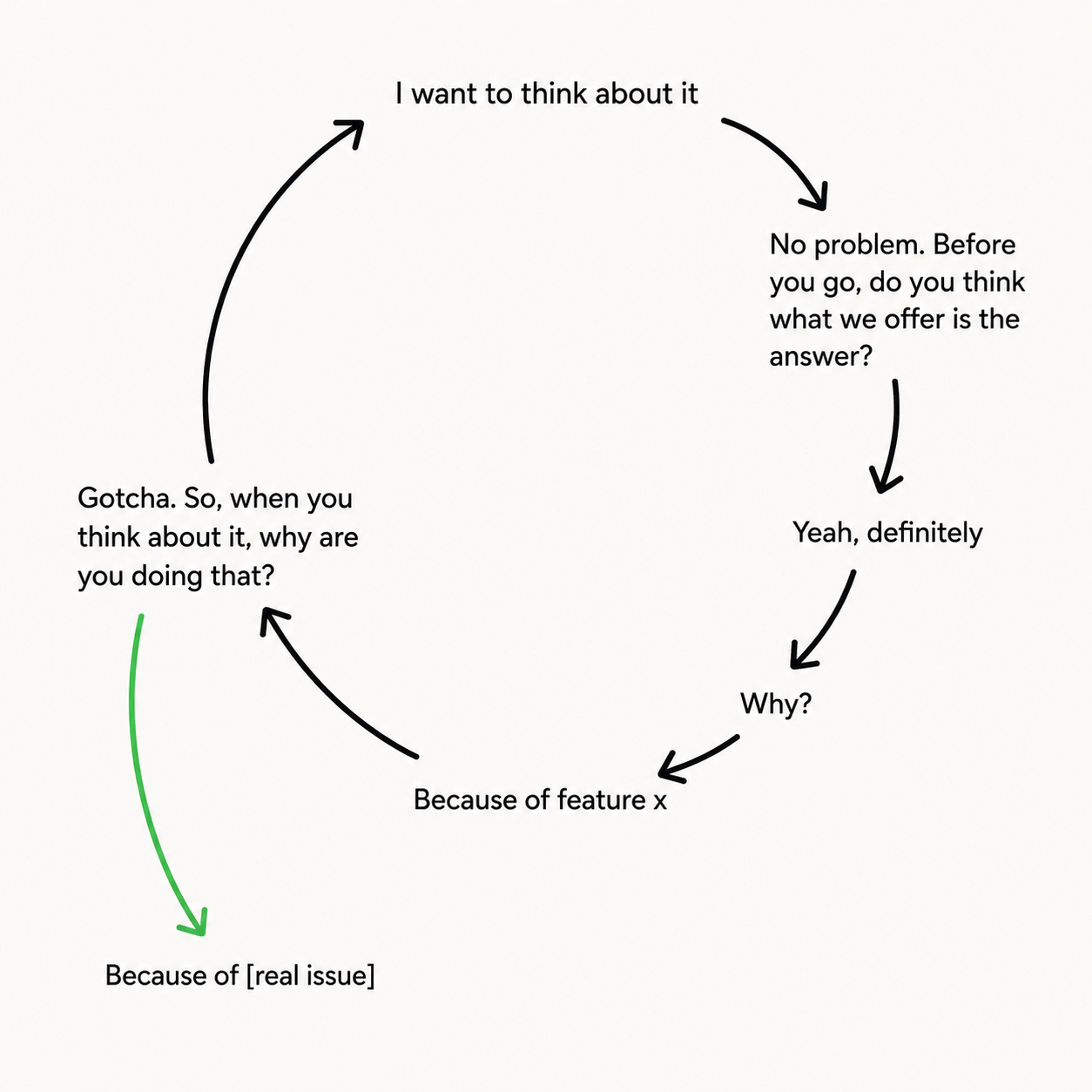
This process is a war of attrition. A substantial component of skill in sales comes down to the ability to calmly, unabashedly guide the conversation into a circular loop until the other person caves and gives an indication of what their reservation actually is. The buyer is lying about their reasons for wanting to leave, and the seller is lying about respecting the buyer’s fake reasons.
This can go on for a long time. A proficient seller can make this circular questioning seem perfectly natural by slightly changing the way the questions are asked.
The reason it works is that the person on the receiving end has to work harder and harder to avoid letting an inkling of their true concerns slip. It is a way of socratically dismantling the obvious dissonance between “yeah this seems amazing and will definitely work”, and “I would really like to get off the call and delay the process of certainly achieving my dream outcome”.
What Does a Rational Refusal Look Like? - The Money Printer
The absurdity of the apparent stance of the buyer is revealed by considering the hypothetical of an offer with maximum value.
Suppose you’re selling them a completely legal $100 bill printer that produces legal tender at a cost of 5 cents per note, for $10,000. It will be delivered same-day, and there are five left in stock.
Obviously, the value of this printer is enormous, and the cost of the printer can be recouped in a minute or two of using the machine.
If the salesman tells you “let’s get you started - what are the first four numbers on the card?”- what are the steelman, rational reasons to tell him “no”?
There are four:
- You don’t believe/trust him, for various reasons:
- Maybe it’s illegal
- Maybe it’s an outright scam, he will take your money, and not give you the printer
- Maybe the money it produces isn’t real and produces shoddy, unusable counterfeits
- A competitor sells faster/better money printers at the same cost, or similar printers at a lower cost.
- You believe more will be in stock later and you can get a better price by waiting
- You don’t have $10k to spend, or it is otherwise logistically impossible to proceed with the deal
“I always think about things like this” isn’t one of them - this is merely an aphorism that functions as a semantic stop sign. Why do you “always” think about things like this? If the reference class of “things like this” is “anything that’s offered to me no matter the offer”, it seems this category contains several cases where delaying “so you can think” is clearly bad, such as this one.
“My business partner might not approve of me making this unilateral purchase” doesn’t appear either. Why would you believe this? Conditioning on the listed concerns being false, if your business partner fails to see the value proposition, then you should veto his decision and secure the printer before it runs out of stock. If he does see the value proposition, there is no use consulting him, and you should secure the printer before it runs out of stock. Neither case permits a delay.
This thought experiment shows that failing to make the decision then and there means that you are uncertain about one of the following:
- Whether it will work
- Whether there is a better deal available to you by either shopping around or waiting
- Whether it is logistically possible for you to buy it
So, when the buyer confirms “yeah, I think this will definitely be the answer for us”, and fails to buy, he commits himself to an absurd position, which gives the salesman an angle of attack.
Sheepishly telling the salesman “yeah, send me an email with the details and I’ll let you know by tomorrow”, is clearly nonsensical in the case where you hold none of the 4 listed concerns.
This is why the simple process of repeating the same question “why do you want to think about it?” in various ways is so effective. The lie becomes more obvious and untenable with each repetition.
So, the prospect has three avenues:
- Assertively interrupt and end the meeting. Difficult in practice if you have established a rapport
- Retreat to another lie (I need to consult with my wife/accountant/priest)
- Or verbalise which of the four rational concerns they actually have
If they retreat to another smokescreen, it is once again a matter of “I totally respect that, no problem. Before you go, can I ask…?”
Most of the time, the effective salesman wins the war of attrition, and eventually, the true concern is revealed.
Well, it IS a lot of money…
Well, she’d be pissed if I bought this and it never arrived…
Well, we have a couple of other quotes to look at beforehand…
The inaction bias of the buyer
Most buyers prefer the status quo and abhor risk to such an extent that it is rationally indefensible. A manufacturer trundling towards bankruptcy due to egregious supply chain inefficiencies will agonise over the hassle and upfront cost of paying a logistics company to fix it.
Selling to them successfully thus involves eliciting the two dissonant positions:
- This costs $100,000 and that’s expensive
- Without buying it, or something like it, I will lose $10,000,000
Many buyers stop their analysis at the first observation, and fail to connect it to the second. In such a case, the salesman is genuinely helping them understand and internalise a better way of analysing their options.
This is what’s referred to as “the cost of inaction” in sales theory. This is the most important component of the initial sales conversation, more important even than the dream outcome itself. In a world where all buyers are rational, the counterfactual impact of the product or service would be weighed automatically against the alternative of continuing to do what they’ve been doing. Almost nobody does this in practice. “If you keep churning clients at your current rate, where will the business be in a year?” is a question that forces people to perform this valid counterfactual analysis, and it often reveals that their decisions are not factoring in the default outcome whatsoever.
If you do not change direction, you will likely end up where you are going
The Carrot And The Stick
Establishing the cost of inaction is far more effective when it is done before the customer objects, rather than after. Once they’ve told you they’re gonna think about it, their guard is up, and they will be defending themselves against the motive underlying your arguments.
This is why, before the dance begins, the skilled seller innocently teases out the cost of inaction from the buyer’s own mouth, so he can reference it later on to challenge the buyer’s love of inaction.
Buying something expensive is rarely a matter of cold calculation. All decisions ultimately relate to emotions and values - the things we buy are merely instrumental to the satisfaction of these deeply held emotions and values.
For instance, a cafe owner buying a new machine:
He already has a second-hand Wega Polaris behind the counter. It makes coffee. But, the steam pressure dips during the morning rush, the left group runs slightly hotter than the right, the buttons stick, and every few weeks some tiny stupid thing breaks at exactly the wrong time.
Now he’s on the phone with a sales rep from La Marzocco, asking about a $30k Linea PB 3-group.
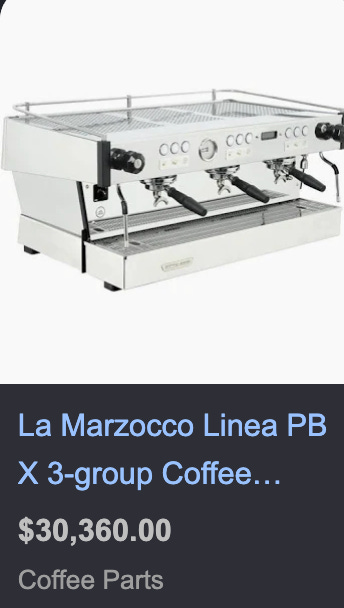
Superficially, he wants a machine that works consistently so the damn thing doesn’t keep overheating and require constant ad hoc maintenance. But consistently functioning machinery is merely an instrument to his true goals. Why does he want this pricey machine?
Because he doesn’t want to have to constantly fix his machine.
Because he doesn’t want downtime, losing him reputation and customers, and money.
Because he wants to be able to run a successful business.
Because he wants money.
Because he wants to provide a good life for his children.
Because he loves them, prays for their happiness, and fears for their safety.
In a few steps, we’ve gone from a logistical hassle about a malfunctioning nozzle, to the man’s emotional core. In every purchase we make, these motivations are lurking. Without emotionally loaded or value-laden preferences, we would have no imperative to make any purchases, or decisions, at all.
The skilled seller recognises this, and seeks to connect the terminal goal of the buyer to the instrument he sells.
There are two poles of his motivation: he prays for their happiness, and fears for their safety. A heaven to strive for and a hell to avoid. A carrot and a stick.
Before any request for a sale is made, the seller needs to tactfully elicit the terminal goal, and vividly contrast the dream outcome against the nightmare. This can be incredibly powerful and largely invisible to a naive buyer. People love talking about themselves, and with a good rapport established, it is surprisingly difficult to maintain your guard when the questioning meanders to increasingly personal topics with no apparent goal.
This is done through feigned curiosity and leading questions. “Oh, interesting. And why’s that?” “Really? Oh, wow, is that having an effect on you, personally?” “Sixty hours a week! Jeepers creepers man, you must be exhausted!” “Yeah that could be trouble, what happens if you just stick with the old machine? It couldn’t hurt to wait another year, surely?”
The goal is to get the buyer to visualise the realisation of the dream outcome as emotionally as possible, and then bring them crashing down with “curiosity” about what happens if they proceed as they have (translation: don’t buy the thing), and end up in the hell they most fear.
The thing that makes this powerful is that it is almost a completely valid argument.
The fallacy conflates the notion of “taking some action” or “not continuing as you are currently” with “buying specifically this thing from specifically our company”. In a syllogism, the trap is obvious:
- You want to achieve goal X
- You don’t want to suffer consequence Y
- If you continue as you have been, you will fail to get X and experience Y
- Therefore, to achieve X and avoid Y, you should not continue as you have been
- Therefore, you should buy our coffee machine
If the argument stopped at 4, this might be a valid and sound argument. 5, however, is a blatant non-sequitur.
The technique lies in the subtle conflation between 4 and 5, combined with the fact that if someone has never consciously considered the true 1-4 argument, it can be quite emotionally overwhelming, distracting you from the move that’s being pulled.
The reason this is done before making the ask and not after, is by the time you’ve asked for the sale, the defenses are up, and now everything is scrutinised carefully. However, if you’ve established that they absolutely must do something now, not later, before getting “down to business”, that idea is a matter of established precedent (and the buyer’s own idea, no less) and is no longer subject to questioning.
Careful Taxonomy Is Make or Break
Once the war of attrition has been won, and the general concern has been voiced, the seller must diagnose the exact species of concern.
“Money” as an issue entails either:
- The buyer has enough money to buy it, but isn’t certain it will work (money: fear)
- The buyer doesn’t have enough money to buy it regardless of whether it works (money: logistics)
Showing them your glowing testimonials is futile if they have $20 in their account.
Negotiating finance options with a person who doesn’t trust you will just irritate them.
Fear being the issue entails either
- This won’t work because of me (fear: themselves)
- This won’t work because of them (fear: trust)
Giving them a pep talk about backing themselves and burning the boats will be fruitless if they don’t trust you.
Trying to dig into the reasons why they are secretly distrusting you will only erode their confidence if they were merely worried about themselves following through.
Thus, “handling” an objection is a delicate exercise of tactful diagnosis. The salesman needs to identify what the true concern is before committing to a response.
Handling successfully elicited, real objections
Once the real concern is articulated, what remains is a game of rock paper scissors where the seller gets to go second.
The buyer’s reasons for refusing to immediately proceed are either rational, irrational, or a combination.
First, the four rational reasons. These must be met with rational responses.
- You don’t believe/trust that it will deliver the result
If, by the time you ask for the sale, a prospect doesn’t believe that X will deliver desired result Y, based on anything resembling an impartial analysis of the available information, no tricks will save you.
“Handling” this is a matter of showing the receipts, or packing it up. Do you have case studies? Product reviews? Testimonials? The correct certifications?
If you have nothing at all, you’re in for a tough time.
- Better deals are available
If a genuinely superior offer is available to the buyer, and they know this, then the only irrational thing they have done is attend the meeting in the first place. If a business has absolutely no valid argument that, for a certain customer profile, their product or service is truly the best option, then that business dies.
Therefore, this objection is largely a matter of adequately communicating your legitimate value proposition (generally well before they’ve had the chance to object). If you can’t do this consistently, this is a PMF issue, not a sales issue.
- Waiting beats not waiting
There are some cases where waiting does genuinely beat not waiting. Perhaps there are budget considerations that incentivise waiting till the next financial year.
However, it is crucial to distinguish between this case, and the much more common, verbally identical smokescreen that functions merely as an excuse to get off the phone without too much of a fuss.
In the minority case where timing is a legitimately prohibitive factor, various commitment devices are at the seller’s disposal. Deposits and contracts work well. After all, if it’s truly just a matter of when, not if, what’s the problem?
“Oh no we can’t commit to that either, let’s talk next quarter” means there is more than mere logistics at play, and the decision is not made. In that case, all that can be done is to calmly smile, and lie to them.
“Totally respect that, no problem at all.
Before you go, though, can I ask…”
- It is financially/logistically impossible to proceed
True logistical problems can be addressed with logistical solutions. If they’re raring to go and have no reservations, but don’t get paid until the end of the week, then take a deposit, sign the contract, collect the card details, and it’s a done deal.
It is rarely truly logistical.
What remains are:
The Irrational Reasons not To Buy
You cannot reason a man out of something he was not reasoned into. - Jonathan Swift
There are many presentations, but they all ultimately relate to the same, deeply rooted reservation, biasing us toward inaction, which is the:
Fear of it all going wrong somehow
It’s common for a buyer to fully accept, intellectually, that the thing being sold is what they need.
But, like a bungee jumper who enthusiastically paid and signed up for the privilege of diving off a cliff, at the last moment, they freeze. All of the reasons are still there: It’s a once-in-a-lifetime experience, they’ve got 5-star reviews, it’s statistically safer than the uber they took on the way… but they still can’t budge themselves from the platform.
What if it all goes wrong?
The right solution for the bungee jumper is to press the button and send them flying.
However, this solution is (fortunately) not at the disposal of salespeople who don’t already have your card details. So, the next best thing is a motivational speech.
This is where the Belfort-esque “Believe you me, Mr. Johnson” routine comes in. Only once you have painstakingly hacked your way through the countless defense mechanisms, lies, and smokescreens the buyer has thrown at you, and confirmed with some confidence that all that truly stands between the buyer and the buying is a bit of gumption, can you use this misunderstood, yet devastatingly effective technique.
The motivational speech is most effective when tied back to the carrot and the stick. Reminding them that it’s all risky, and that there is much to be gained if only they could take the leap, is the only way to stir them from inaction.
I can appreciate that, Mr Johnson. But, can I level with you here? … There are no guarantees in this life. I could be standing here showing you a million testimonials showing our services transforming the lives of our clients instead of a thousand. But if you aren’t able to put a line in the sand, and back yourself to make a change, so that you can buy yourself that house in the valley, and find some peace in your life for once, then you’ll still be where you are: five years from retirement, getting closer by the day to shutting the doors of the family business for good. So, can I ask you, are you willing to make a change here, and work with me to get you to the 6-figure months, and take charge of your business and your life?
Corny and somewhat patronising, certainly. But, with good rapport, a big enough carrot, an urgent, emotional stick, and no other concerns about the value of the offer, this will seal the deal four times out of ten. Far better than sending an email with the details and looking forward to hearing from you.
Or, just bullshit them
Not everyone is comfortable delivering motivational speeches, and so, lacking an ability to deliver a straight-faced, sincere-sounding motivational speech that ties in to the personal worries and dreams of the buyer, there is also the option of bullshitting them with a fallacious argument.
The most common one being:
You have a tendency to be uncertain, and this has produced the result of you not having XYZ, which is what you want. If you maintain this uncertainty, you won’t get XYZ, as evidenced by your current situation. Therefore, to get XYZ, you need to change your way of operating, and take decisive action by buying from us.
When this absurd argument is delivered through questions, with the right timbre of sincerity, it is surprisingly effective.
The argument is straightforwardly invoking post hoc ergo propter hoc, and can be reduced to absurdity by simply substituting “uncertainty” with any other thing they tend to do.
You have a tendency to have evening bowel movements, and this has produced the result of you not having XYZ, which is what you want. If you maintain this practice of nocturnal defecation, you won’t get XYZ, as evidenced by your current situation. Therefore, to get XYZ, you need to change your way of operating, and take decisive action by communing with nature at sunrise.
The reason this works to overcome the last-minute jitters is that there is usually a kernel of truth: people do tend to be indecisive to a detrimental extent, and would be better off just making the call and committing to it. For many people, having this pointed out strikes a chord, which makes the conclusion seem fair despite the argument being invalid.
Another amusing bullshit closing argument from the infamous sales trainer, Andy Elliott, on selling life insurance (paraphrased):
“If I asked you to write a check for how much your family’s safety and security was worth you wouldn’t be able to write enough zeros on the page, am I right?” yes “But if you could, it would sure be a hell of a lot more than $99 a month, right?” yes “Great, then let’s get this done” [offer handshake].
Arguments of this form are common. The goal is to emphasise the value of the result - the thing they’re truly buying. In comparison, the price seems trivial. Sure, my family’s wellbeing is of utmost value, far greater than $99 per month - and I can buy it for $99 a month, sounds like a deal to me!
However, as Eliezer Yudkowsky points out, it is not enough that you value your family’s safety at >$99/mo for you to rationally purchase the product.
“To extract $77 from Arnalt, it’s not a sufficient condition that:
- Arnalt wants one Oreo cookie.
- Arnalt would derive over $77 of use-value from one cookie.
- You have one cookie.
It also requires that Arnalt can’t buy the cookie more cheaply from anyone or anywhere else.”
You must be unable to buy an equivalent amount of your family’s safety for less, from someone else, for this argument to be valid. Otherwise, why wouldn’t they be selling the insurance for $999, or $9,999? The argument seems to hold irrespective of the price.
Not to mention, of course, the implied (likely false) claim that what you are buying will indeed result in any improvement whatsoever to your family’s wellbeing.
Neither party leaves with clean hands
In a sales conversation, both the seller and the buyer tend to tell a great deal of lies, and make many bad arguments. The more expensive the offering, the harder it is to maintain complete honesty for both parties, even with good intentions.
The buyer lies mainly because of his instinctive, partly rational, often overcalibrated defensiveness. The seller, feigning interest for the lies he hears every day, lies in response, as it’s the only way to get the buyer to be forthcoming.
Until the buyer develops a great deal of self awareness, or the seller’s offer improves to the level of a money printer, the dance of lies and fallacies is certain to pervade all the negotiations to come.
Caveats, acknowledgements, and limitations
- While these practices are virtually universal in some form or another, many of the specifics and dialogue trees are (modified versions of things) attributable to Bill Walsh, Jeremy Miner, and Matthew Ryder. This is not an endorsement of them, their methods, or the things they sell.
- Not all products can or should be bought in the course of a single meeting. As companies get larger, there are layers of bureaucracy that limit the speed of making deals, even for money printers. This essay applies largely to SMBs and B2C sales, not enterprises - however, most of the underlying principles are universal.
- The discussion of sales techniques in this essay assumes the business is real and legal, and that the customer has some want or need for the thing being sold. Contrary to popular belief, it is rare for sales people to simply make outrightly false claims about what the product is or what it does. The “ah yes, Mr. Johnson, this boot polish will assuredly make your hair grow back as thick as ever” style of selling is not particularly common, and is beyond the scope of this essay.
- There are many ways to skin a cat. This is a way, not the way. Most salespeople don’t do most (any) of this and scrape by with industry standard conversion rates.
Discuss