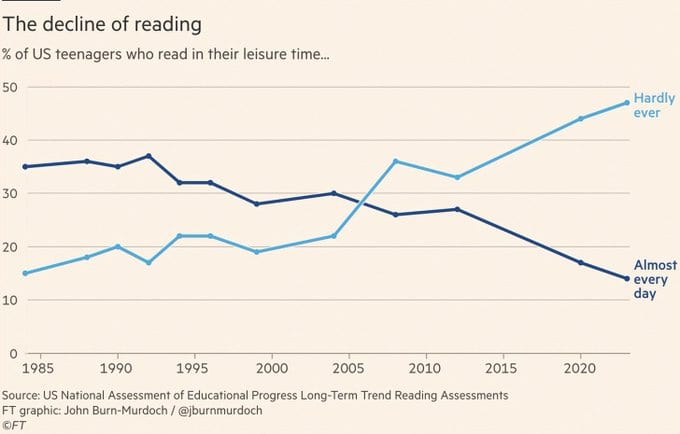
Reading is the most fundamental thing in education. If you can read, you can do and learn everything else. If you can’t read, well, you’re screwed.
We know how to teach reading to children. Phonics. The weird thing is we often choose to not do that, and instead to use methods that are known not to work. Principles often want to not do phonics. Teachers often heavily resist phonics. But yes, you can absolutely overcome this, as Mississippi and other Southern states have done, by insisting upon it and actually enforcing that insistence. You see huge gains.
Not all those gains persist into later grades, but a lot of the gains do persist.
No, that won’t get the children invested in reading lots of books on their own time. But given their alternatives and what we inflict on them, can you blame ‘em?
First, it’s not just Mississippi — Louisiana, Alabama, and Tennessee have adopted the same strategies, stemmed the bleeding affecting states elsewhere, and seen significant improvements.
Second, many people who aren’t too focused on education policy seem to imagine Mississippi has simply stopped underperforming, that they’re now doing about as well as everyone else.
This is not true. They haven’t just caught up to your state; they are now wildly outperforming it. If you live where I do, in Oakland, California, and you cannot afford private education, you should be seriously considering moving to Mississippi for the substantially better public schools.
The states adopted reading curricula backed by actual scientific research. This led to them adopting phonics-based early literacy programs and rejecting ones that used the debunked “whole language” method that encourages students to vaguely guess at words based on context instead of figuring them out sound-by-sound.
This is the part of the story that has gotten the most attention — teach phonics! And you should, indeed, teach phonics. But making schools adopt the approach took more than a mere nudge. The Southern Surge states have tried earmarked funding, guidance to districts, and outright mandates to accomplish universal adoption.
… The second pillar, White told me, is “a scaled system of training those teachers on that curriculum — most teaching you get as a teacher is not training on the curriculum.”
… The third pillar is everyone’s least favorite, but it’s equally crucial. “Number three is clear accountability at the district level, at the school level, at the educator level, and at the student and parent level,” White said.
Sharon Lurye (PBS): All three states have trained thousands of teachers in the so-called science of reading, which refers to the most proven, research-backed methods of teaching reading. They’ve dispatched literacy coaches to help teachers implement that training, especially in low-performing schools.
They also aim to catch problems early. That means screening for signs of reading deficiencies or dyslexia as early as kindergarten, informing parents if a problem is found and giving those kids extra support.
Karen Vaites: The Southern Surge shares a common playbook. All four states made a multilayered, sustained investment in both teacher training and curriculum improvement, alongside other reforms.
Together, these states send a clear signal that we can absolutely raise reading outcomes with the right investments, and they offer a blueprint to other states.
I note that such investments do not need to involve on net spending a lot more money.
Karen Vaites: The Southern Surge cements the case that money is not everything. All four states are in the bottom half for per-pupil spending, and Mississippi and Tennessee are in the bottom 10.
The biggest takeaway is that investments must be multilayered and sustained.
…
By 2016-17, [Louisiana] was beginning to require districts to use high-quality programs; by that point, state leaders had enough buy-in to make that move, according to Rebecca Kockler, a Deputy Chief at the time.
Fresh legislation in 2021 and more in 2022 ushered in a wave of ‘science of reading’ reforms: By the 23-24 school year, all K-3 teachers were required to takeScience of Reading training (minimum 55 hours) from one of four approved providers. New literacy screening was introduced in ‘22, with a requirement to notify parents of below-benchmark readers.
Teacher certification was strengthened, three-cueing was banned, and a third grade retention law passed (going into effect this school year).
Still, the cornerstone has been the curriculum work. It continues to anchor Louisiana’s comprehensive literacy plan.
[In Mississippi]: The Literacy-Based Promotion Act introduced new requirements for K-3 literacy screening, paired with parent notification for struggling readers. The state sent literacy coaches into the lowest-performing schools for 2-3 days a week, all year long.
In low-performing schools, teachers were required to take intensive LETRS training on reading foundations.
The 2013 Act also introduced a third-grade retention requirement for children who weren’t reading successfully by the end of third grade.
The state shifted gears in 2016, and began encouraging the use of high-quality curriculum. … In 2021, the state released curriculum reviews, developed in partnership with EdReports, identifying six programs as high-quality (EL Education, CKLA, Wit & Wisdom, MyView, Into Reading, and Wonders). By 2024, 80% of districts had adopted one of these curricula in K-5, thanks to coaching by the state as well as grant funding for new materials and paired training.
Some of this does involve extra time and money spent. A lot of it doesn’t. A lot of this is as simple as requiring replacement of curricula with ‘high-quality’ curricula. When you see failure cases, like how Karen Vaites describes Wisconsin, they reliably involve not ‘we cut the funding’ but rather ‘we used three-cueing or otherwise not phonics.’
I’d consider retention in third grade a fourth pillar. Essentially the playbook is:
Phonics.
Train the teachers to do phonics.
Hold everyone accountable if they don’t do phonics or it’s not working.
Kids and parents have skin in the game because they’ll be held back, and the kids who need more time to catch up get that time.
Matthew Yglesias: Teaching phonics works. Passing laws that say “we’re going to teach phonics now” (which is very common) has a much more mixed record. What’s impressive about Mississippi is actual implementation.
The actual implementation seems like a solved problem now, we simply copy it? And how hard is it to at least insist that everyone use this very clearly superior technique?
Spies In Every Classroom
People like to make life a little tougher than it is.
Matthew Yglesias: For starters, you’re just not realistically going to infiltrate every classroom with spies who’ll make sure nobody is secretly using the wrong books or telling kids they can guess the word based on the picture. But beyond that, unmotivated “doing the minimum” teachers aren’t going to do a very good job. You need enthusiastic, engaged teachers who believe in what they are doing and are excited about improving literacy instruction.
Oh, come on. You already have ‘spies in every classroom,’ they are called the students. It is trivial to pick a random student periodically, ask them what teaching methods are being used, and if it isn’t phonics you deal with it. You think teachers can just ‘go rogue’ and use an entirely different curriculum and you won’t know? In many schools we already dictate the lessons on a per-day basis in minute detail, and that is not obviously a good idea but you can very obviously do it if you want to.
Similarly, New York has support for this from the teachers’ union, and the principles are throwing a fit, but yeah you just do it anyway and if the principles don’t like it they can quit and if they refuse you can presumably demote or fire them.
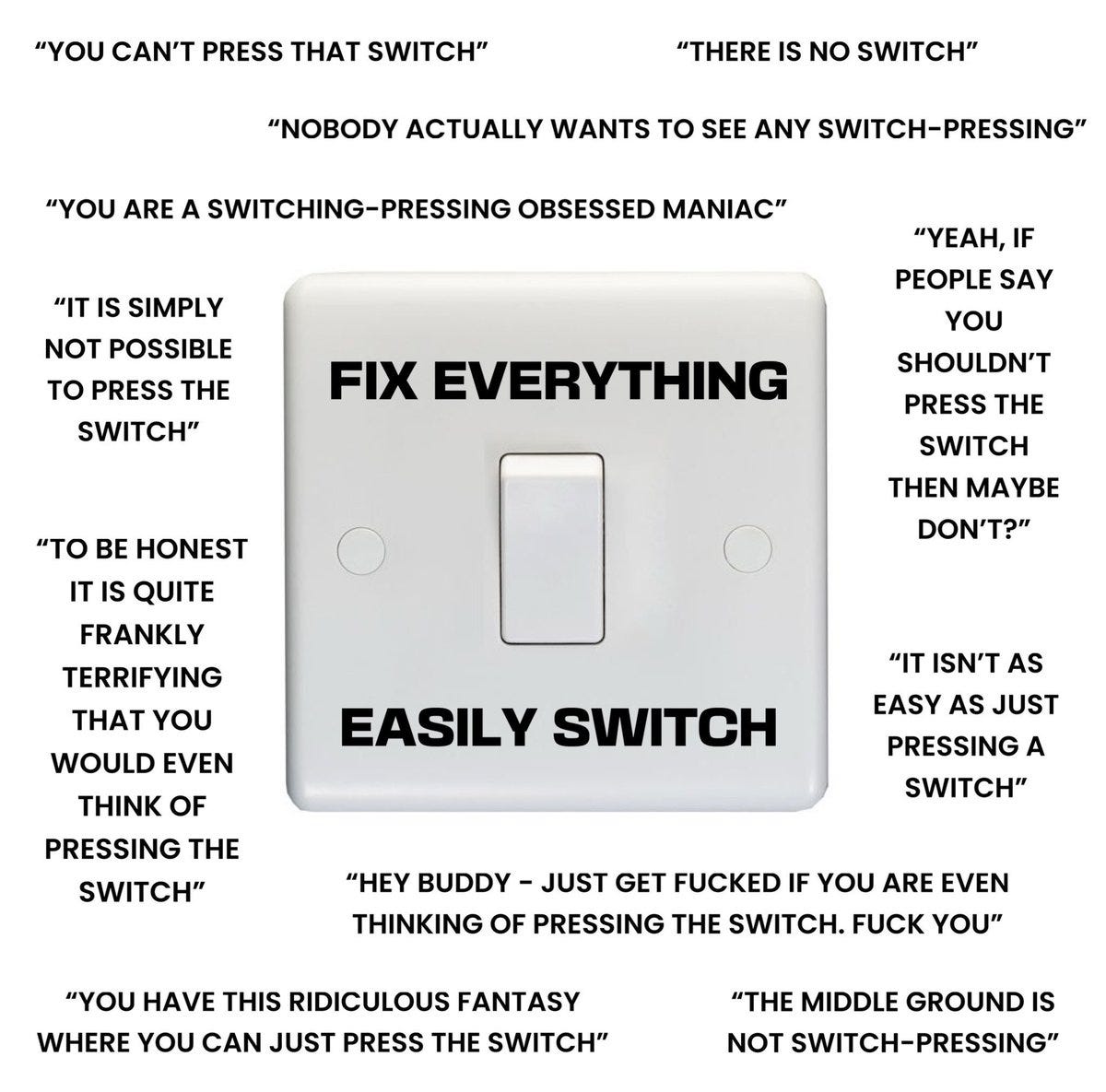
So again, no it’s not quite this switch…
…but it’s close.
Mississippi Results Are Not Due To Retention
A viral article from Wainer, Grabovsky and Robinson argued that the results are mostly the result of the third-grade retention policy. The frame presented is ‘this is an education miracle, and almost all education miracles are selection effects or worse.’
As previously mentioned, the latest NAEP data for 2024 show even more impressive, “miraculous” results on the fourth-grade literacy test scores – a tie for 8th place. Strangely though, for the eighth-grade literacy test, the state’s rank dropped to a tie for 42nd place! This should clear up any miracle illusions that may remain.
Need more proof that Mississippi public education is without miracles? The 2024 NAEP fourth grade mathematics scores rank the state at a tie at 50th! The eighth-grade scores also qualify for 50th place. This is certainly consistent with the Mississippi that most of us know
There’s a remarkable arrogance here, a continuous assertion that all of this is obvious and overdetermined, similar to that of Michael Green’s viral claims about poverty, talking about those who fell for the whole thing as ‘duped.’
In both cases, we not only then see factual errors, we see entirely invalid methodology.
Here we go.
Kelsey Piper: This is an important debate, but I’ve been dismayed to see their article treated as a significant contribution to it. It’s badly mangled with straightforward factual errors that should undermine anyone’s confidence the authors did their homework — for example, the authors claimed that “the 2024 NAEP fourth-grade mathematics scores rank the state at a tie at 50th!” In fact, Mississippi ranked 16th on the fourth-grade math NAEP assessment.2 Unsurprisingly, the authors’ errors are not limited to these sorts of factual claims but also extend to their core argument, which is wholly unpersuasive.
Last place among states versus 16th is a rather extreme factual error, although that particular error is irrelevant to results in reading.
Kelsey Piper: Strangely, the paper treated holding back 5% of students as identical to truncating the lowest 5% of test scores.
… A student that repeats the third grade does not conveniently vanish off the face of the earth. They just … take third grade again, and then they move on to fourth grade. The state still tests them; they just do so a year later.
Wainer et al.’s mathematical analysis doesn’t look at what happens when you delay students one year, it looks at the effects on overall test scores of *vanishing* the bottom 10% of students. Which obviously didn’t happen. And indeed, if you kicked all of those students out of public education, it would increase your average test scores by about as much as Mississippi’s test scores have increased.
… That’s not what’s going on at all. If a student is held back a year, they still take the test again when they do reach fourth grade, a year later. Under Mississippi’s retention law, a student can usually only be retained for a maximum of two years.
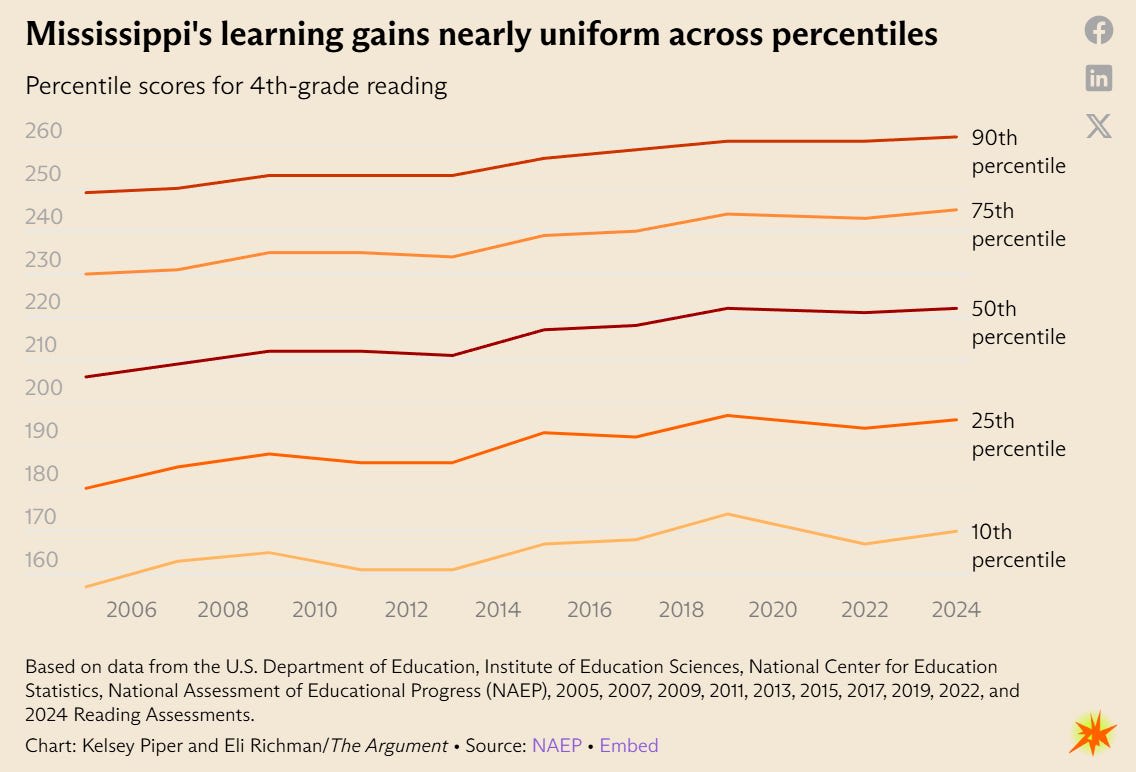
More to the point, if you look at the percentiles, Piper notes, ‘we cut off the bottom decile’ is clearly not what is primarily happening:
Kelsey Piper: In 2013, only 3% of Mississippi’s fourth-grade public school students earned the highest score on the NAEP reading test. That has now more than doubled to 7%.
Plus the timing doesn’t work, again see the graph, also retention declined from 9.6% to 7.2% from 2018-2022:
Kelsey Piper: Much of Mississippi’s rise started before they changed their third-grade retention policies (which they did in a 2013 law, first fully in effect in 2015). Even if you think all of the continued improvement since they changed third-grade retention is attributable to the change in retention policies, you should be curious what they did before then!
And the average age in the 4th grade did not substantially increase:
Lastly, in 2019, when this controversy first reared its head, some researchers looked at the average age of students in Mississippi taking the fourth-grade test. They found that the average age in Mississippi is higher than in many other states — Mississippi holds more students back from the next grade than most states do — but that it has not risen since 2000. That’s at least a bound on how much retention rates could have increased.
At which point, if the retention policy is the secret sauce, good, let’s copy that policy.
It’s not crazy to think that retention could be doing a lot of the work, via the additional mechanism of providing strong incentives to everyone involved.
Is Retention Helpful In General?
Does holding marginal students back help them or harm them?
One has to think on the margin. The correct amount of retention is obviously not zero.
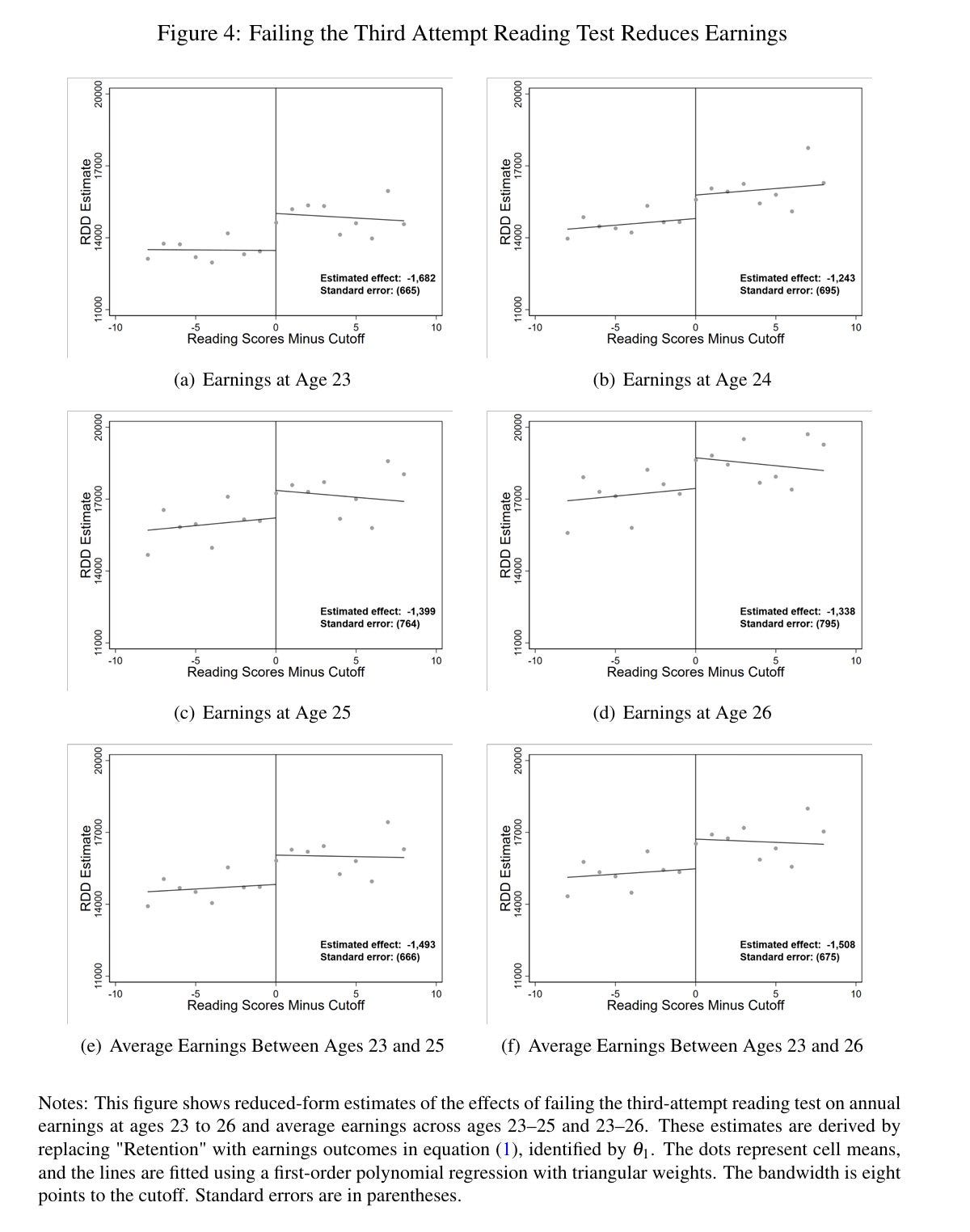
Kelsey Piper: research has generally found Florida’s third-grade retention program doesn’t impact odds of finishing high school, but this analysis finds that Texas’s third grade retention program did – big deal if true.
estimating the impact of retention policies is harder than this, because most of the claimed benefit is marginal students improving their skills to avoid retention, but it’s still a big deal if retained students have reduced graduation rates (as appears to be the case here)
Charles Miller: It seems like the study’s approach didn’t control for precisely this effect. It looked at students just above and just below the threshold on the assumption that they’re basically the same skill level. But if the benefit of retention is mostly pushing some marginal students to increase their efforts and skills to get above the threshold, then I might even suggest the study shows the opposite effect to what it suggests.
Kelsey Piper: In principle I think you can use a fuzzy discontinuity here; the students on either side of the margin are presumably both trying to make it across the line
Note that these students are in deep trouble either way, as the average for age 26 people in Texas is on the order of $45,000.
I note, before examining the paper, my willingness to defy the data. There is simply no way that holding a struggling student back for one year reduces earnings by 19% at age 26. That’s way too big an effect. It would be one of the biggest effects in the history of education.
This is only significant at the 10% level ($1338 difference in earnings by cohort with SE of $795), so it could simply be noise. All six graphs above are the same groups.
Another reason to defy the data is that redshirting, or holding kids back on purpose when they are near the age cutoff so they’ll be older within a grade, if anything helps them on net.
Actual retention reduces high school graduation by 9%, but on the margin there’s no difference in graduation between non-retained students who fall short on the test versus those who pass, both are 58%. That’s suspicious, since you’d expect a selection effect based on who manages to avoid retention.
Looking at the paper, a lot of the gap in earnings is intensive margin of work. Another issue is that the cutoff is not clean. The paper assumes that the 65% who fail the cutoff but get promoted anyway are not impacted by failing the cutoff. We can’t assume that, and indeed the 58%s matching implies that being ‘almost retained’ is itself damaging, as something has to cancel out the selection effects, which would drive down the average impact here. And the age 26 number happens to be the largest measured impact.
If the effect is real, I’d actually propose a very different mechanism as the only thing that makes sense to me: School is actively bad for these kids. The system already failed them. An extra year won’t save them academically, and this postpones their ability to go out into the world, get jobs and learn real skills they can use. These kids don’t need retention, they need either intensive tutoring or they need apprenticeships.
At Eighth Grade A Lot Of This Improvement Remains
That still leaves one important counterargument. The 8th grade reading and other scores did not much improve. We shouldn’t care so much about 4th grade reading that doesn’t result in that many gains in 8th grade. It did go from 50th to 41st, that’s nothing to sneeze at, but it’s not 49th to 9th.
Kelsey’s response to that is in a previous dedebunking post, where she measures the gap between Mississippi and the average state on the 8th grade test, and notices it shrunk by two thirds, while their 25th percentile scores had drawn even with the national average.
That degree of fade out is disappointing, but not obviously surprising, and the efforts still seem worthwhile.
Karen Vaites: In the 2000’s, England was slipping badly in international rankings for both reading and math.
Today, it’s 4th in the world in reading, and rising swiftly in math.
What did England do?
Mandated phonics in early grades curriculum
Shifted to a knowledge-centered curriculum
Introduced a phonics check assessment in early grades
Later added a similar math check, to ensure all kids had fluency with basic math facts (knowing their times tables)
Reformed to teacher preparation
And more.
The problem with fixing that many things at once, and doing it across a unique nation, is that you don’t actually know which parts mattered. But the lists of successful interventions do seem to all start to look the same, starting with reading is always phonics.
Mastery Learning is where you focus on, learn and drill key foundational skills or knowledge, such as multiplications tables, and don’t move on until you nail them. Phonics and Direction Instruction are related.
Despite all the evidence it works where many alternatives flat out do not work, schools moved away from phonics, and similarly many schools no longer teach multiplication tables. This does appear to be madness.
Arnold Kling: Consider two hypotheses:
Mastery learning works, but educators refuse to adopt it.
Mastery learning does not really work. Instead, good results appear only in special settings in which teachers and students are highly motivated to make it work.
The best evidence for (1) is the way that phonics got taken out of reading education and is making a comeback. Throwing it out appears to have been a very misguided idea that came from the education establishment.
The best evidence for (2) is the fact that mastery learning has stayed within a narrow niche of schools. As an economist, I subscribe to the view that there are not $20 bills lying on the sidewalk waiting for people to pick them up. If mastery learning is that proverbial $20 bill, then those not picking it up include not just union-dominated public school districts but fancy private schools, charters, and home schoolers.
The obvious response is that mastery learning is not a $20 bill lying on the sidewalk because providing a better education to our students does not result in the educators and ‘education experts’ pushing their agendas making an additional $20 or rising in status. They have skin in the wrong game, their game involves joining the war on education and not on the side of education. There’s nothing suspicious there.
One could ask, what about fancy private schools? Again, do they win by providing better educations, or by playing social games that attract wealthy and high-status students? How would a parent get the schools to care about the right things for real? Who is looking down at the sidewalk, seeing a $20 bill, and not picking it up?
The War Against Reading
One can add a fifth pillar to the four used in Mississippi, which is don’t actively stop kids from reading? You don’t actively sabotage any child who is doing well?
While several southern states teach children to read, blue areas take aim at the opposite goal, ensuring that the kids stop, which includes ending all gifted and talented programs, and then ruthlessly attacking those kids until they stop trying to be gifted or talented to ensure classroom equality.
Greg Lukianoff: I worked with gifted black and brown kids in Washington, D.C. in the mid-90s and I always find these attempts, almost always in the name of racial equity, to be such a slap in the face to those kids who finally got to feel normal for once in their life.
They NEEDED to be around other smart kids or else they just felt like weirdos and outcasts.
As someone else wrote, high IQ IS a special need and it’s not one that our society can afford to squander
AND it’s cruel to squander it for kids who otherwise could be bright, excited, full of hope and feeling seen for, perhaps, the first time in their lives.
Hannah Frankman Hood: You’re a five year old. You love to read. You can read chapter books. You’re excited to start school in the fall.
Then you actually start school. You’re stuck doing basic literacy. The rest of your class can’t read. You’re not allowed to read your books.
You’re frustrated and bored. Your classmates mock you. They call you a weirdo. You feel like an outcast.
You decide school is actually terrible. You hate it.
Now you’re fifteen. You still hate school. You have no idea it could’ve all been different if you’d been allowed to learn at your level.
Don’t fall for those saying they ‘only want to phase it out for kindergarten’ or anything like that. That would be bad enough, and also they’re definitely lying, and lying in wait for the chance to finish the job. Every time.
We force a ton of reading upon them and they have phones and computers, on which they are constantly also reading. Dedicated additional reading that ‘counts as reading,’ especially books, seems like a rather hard sell.
No One Reads Anymore
Kevin Roose reports back from liberal arts college that reading is indeed dead.
Kevin Roose: The “students don’t read” meme appears to be real. Profs there don’t assign full books anymore, even to English majors, because nobody will read them. Only chapters/essays, and even that’s pushing it. (Not a literacy issue, per se — more of a focus/time management issue.)
What is the point is of majoring in English if you’re unable to read books? Or even if you do not especially want to be reading a lot of books?
Here is a claim from Alden Jones that current college students have lost all capacity to read much of anything, and that we desperately need to bring back reading physical books and writing with pencils or pens. I believe the first half, and that Covid ‘broke the seal’ in ways that are not getting undone. I’m not sure about physical reading or especially writing, except that it is the only practical way to get off of one’s device. That does seem like a good enough reason for many, even if I can handle it now?
And yes, I believe students (as reported here) went from asking permission to miss classes to announcing they’ll miss classes and even tests, and that does sound like it went too far. But also colleges were also sometimes kind of insane about ‘we will ruin your life plan if your competition means you can’t get back by Monday at 1pm that one time’? There has to be a middle ground between the students and classes where attendance doesn’t matter at all, and the ones where they care way, way too much.
Mandated phonics in early grades curriculum