Crossposted from Substack and the EA Forum.
A common argument for optimism about the future is that living conditions have improved a lot in the past few hundred years, billions of people have been lifted out of poverty, and so on. It’s a very strong, grounding piece of evidence - probably the best we have in figuring out what our foundational beliefs about the world should be.
However, I now think it’s a lot less powerful than I once did.
Let’s take a Darwinian perspective - entities that are better at reproducing, spreading and power-seeking will become more common and eventually dominate the world.[1] This is an almost tautological story that plausibly applies to everything ever, agnostic to the specifics. It first happened with biological life in the last few billion years and humans specifically in the last hundred thousand years. Eventually, it led to accelerating economic growth in the last few thousand years, and in the future it will presumably lead to the colonization of the universe.
My core point is this: It makes complete sense that this nihilistic optimization process at first actually benefits some class of agent - because initially, the easiest way to keep growing is to use some class of agent in the world and incentivize it by satisfying its preferences. But then, as the optimization becomes more and more advanced, it stops being beneficial - because there are almost certainly some more evolutionarily fit configurations out there than the class of agent that the process just happened to start out with. It’s a “Darwinian honeymoon”.[2]
That’s very abstract - I’ll give an example. The population of the red junglefowl, the wild ancestor of the chicken, was in maybe the tens of millions, concentrated in the Southeast Asian jungle.[3] Then, around seven thousand years ago, humans started to domesticate them into Gallus Gallus domesticus, the modern chicken, and chicken farming spread through Persia and the Middle East into Europe. By 1700, there were maybe a billion chickens in existence.[4]
At that point - before the Industrial Revolution began - poultry farming was still a small-scale, household affair. Chickens were kept in small wooden coops or henhouses at night to protect them from predators, and let out to free-range during the day. Around half of chickens were surplus roosters, young males not needed for breeding and killed at 4–6 months of age. The other half were mostly laying hens, killed at 2–4 years of age. The most common methods of killing were neck wringing and beheading - both of which result in instant death if done correctly.
This was an enormous increase in the total welfare of poultry: a 100x increase in population, being given extra food by humans, and far more painless deaths than in the wild (where they died from predation, disease, and only rarely old age).[5] From the chickens’ perspective, it would have been an unimaginable, mindboggling blessing. Heaven on Earth. Really take in how extraordinary this is - it’s probably larger than the increase in human welfare from 1800 to today that we are all so excited about! (which involved only an 8x increase in population)
Early domestication was intended for cockfighting to a surprising extent (with use for meat and eggs only starting later), an activity presumably very distressing for the roosters. So there was even moral progress over time!
Chicken intellectuals would probably have been saying stuff like this:
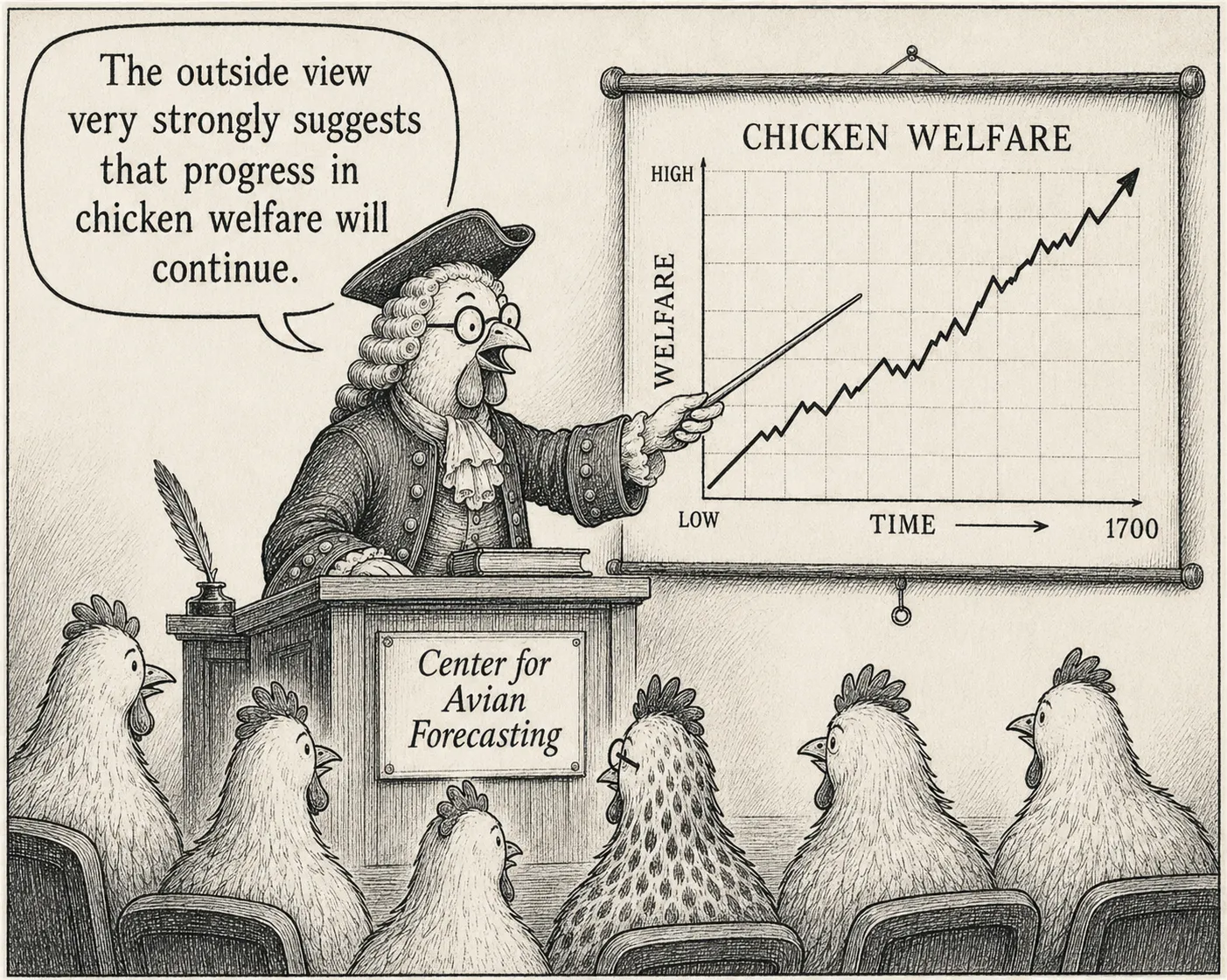
“Maybe us and our human friends will colonize the universe together, and transform the trillions of planets of the Milky Way into endless spacious coops to cluck around in. What a bright future we have!”
Then… things changed.
Today, male chicks born at egg-laying facilities are useless to the industry and are killed on their first day of life - typically by being fed alive into high-speed grinders (maceration) or suffocated with CO₂, with billions killed this way every year globally. Female chicks have a portion of their highly sensitive, nerve-dense beaks cut or burned off without anesthetic within days of hatching, to prevent them from stress-pecking each other. Broiler chickens have been selectively bred to grow so fast - reaching slaughter weight in around 6 weeks - that their hearts, lungs, and legs frequently cannot support their own bodies, leaving many unable to walk, suffering heart attacks, or dying from organ failure before they even reach slaughter. Those in conventional housing live on floors covered in accumulated feces, causing chronic ammonia burns to their feet, legs, and eyes. Laying hens spend their entire lives in battery cages with roughly 61 square inches of space each - less than a single sheet of A4 paper - unable to spread their wings, turn around, or take a single step in any direction. When egg production slows, they are sometimes intentionally starved for up to two weeks in a practice called “forced molting”, to shock their bodies into another laying cycle. At slaughter, chickens are shackled upside down while fully conscious, dragged through an electrified water bath, and passed through an automated throat-cutting blade - a process with a well-documented failure rate. The ones that are improperly stunned or miss the blade entirely proceed directly into scalding tanks of near-boiling water, where they are drowned or boiled alive while conscious.[6]
Chickens had normal, happy lives for most of history because humans needed to “cooperate” with them, in a way - there was no alternative to free-range, and confining them in tight spaces would have made disease too much of a problem. Chickens had some negotiating power, so to speak, just by virtue of existing in their natural form, with their natural preferences.
But then, humans invented antibiotics and vaccines to make extreme density viable. They synthesized vitamin D and added it to feed to make sunlight unnecessary. They discovered mechanized processing made farms with millions of birds possible. They figured out breeding science to grow chickens to unhealthy sizes. They found the right culture, and enough psychological distance in the industrial process, to disregard the chickens’ suffering.
The world optimized itself.
People sometimes use chimpanzees as an analogy for AI - we will be to AIs like chimpanzees are to us, and look at the difference in power there. But this can feel dissonant with the fact that humans are obviously doing amazing right now, in a way that apes never were.
The chicken analogy may help bridge the gap. Chickens were doing so well - until they weren’t.
This makes it feel a lot less surprising that humans are doing much better than 200 years ago, and returns us some extent to a state of ignorance about the future.[7] Of course we’d be doing well for a while - that’s how this stuff works.[8][9][10]
You might just be in the honeymoon phase.
- ^
People that have talked about this being potentially The Most Important Thing for thinking about the long-term future and influenced me: Nick Bostrom, Robin Hanson, Allan Dafoe here and here (I’d recommend the latter), Dan Hendrycks, Carl Shulman, Andrés Gómez-Emilsson.
- ^
It’s also just Goodhart’s Law, I think.
- ^
The source for all facts in this post is Claude Sonnet 4.6, and it’s factchecked by another instance of Claude Sonnet 4.6
- ^
A lot of uncertainty on these numbers, obviously.
- ^
Quick note: I haven’t thought/read about animal welfare, and especially wild animal welfare, much. I take suffering-focused views like Brian Tomasik’s seriously. (and chickens are r-selected and prey animals, which may be bad?). So I am very uncertain in general.
But here, I’m mostly saying that from a “common sense” point of view, these lives seem alright - just like human lives with a distressing death at the end seem alright. So if you believe the human progress prior I’m arguing against, you should also believe this.
The other major counterargument I can think of is that the individual chickens die earlier, especially with the many unneeded roosters. The red junglefowl, in contrast, lives 5 to 8 years in the wild. But from a total utilitarian perspective, this is not that relevant.
- ^
Claude wrote this paragraph with some editing and guidance from me.
- ^
In a more mundane context, all this also made me more sympathetic to left-wing skepticism of unrestrained capitalism. We just can’t control it or know where it’s going, long-term.
- ^
Also, experts tend to think that the Agricultural Revolution (and possibly even the Industrial Revolution for a bit) reduced aggregate human welfare at first. So the outside view of “humans will keep doing better” has failed before - it’s strictly weaker than the outside view of “things will become more optimized”.
My guess is that the total welfare of the world today is probably negative anyway due to factory farming, so that’s another way the optimistic outside view, globally speaking, doesn’t get off the ground.
- ^
The big counterargument is that humans are much more powerful and competent than chickens were - we controlled their lives, after all, and it made it easy for us to “disempower” them. Of course, I agree that the situation is different - the “humans will keep becoming more powerful” outside view fares a lot better than the “humans will keep doing better” outside view - even the Agricultural and Industrial Revolutions involved increases in power for the people at the top. That’s the big question - if humans have enough power and competence to stave things off.
I guess I’m trying to shift the frame - getting outcompeted is the default outcome, unless something weird and unprecedented happens (permanent alignment, value lock-in, stable global singleton, something).
(And at the end of the day, power is not the end goal - welfare is. So it should also worry you that that outside view doesn’t seem very strong at all. That’s more in the direction of something like authoritarianism risks.)
- ^
Very quick, very speculative, lightly held thoughts on how the honeymoon may already be ending: Humans may be drifting away from our natural instincts due to the differing incentives of the modern capitalist world: Lower marriage rate, lower fertility, etc. Worsening teenage mental health may also be a sign of “underlying unhealthiness”/goodharting in some way. And increasing political polarization could be interpreted as human social instincts getting hijacked by larger entities (“egregores”) into larger-scale, more optimally power-seeking conflict. (Of course, there are other possible hypotheses for all these, and they’re completely independent from the main gist of the post).
And AI replacing us is obviously another option.
Also, I’d be remiss not to mention Ben Garfinkel’s blogpost on another concrete mechanism for how our current Golden Age could come to an end: Is Democracy A Fad?
Discuss