For Context on Gift Economies and the previous version of this simulation: https://www.lesswrong.com/posts/iJnFNrcmuT5id3Ju4/a-simulation-of-social-groups-under-a-gift-economy
Github for this project: https://github.com/orthogonaltohumanity/Ancestor-Simulation/tree/main
Ancestor simulations have been a concept thrown around for years now so let's build one, with a twist. Instead of simulating the minds of every individual I simulate the mesoscopic properties of ancient society. Specifically groups of around 7 to 15 people (because I only have so much RAM). I believe taking a mesoscopic or macroscopic lens to ancestor simulations, i.e. looking at ancestral society rather than ancestral individuals, is a good approach if the goal is to actually learn about society in the past rather than using ancestor simulations as a vehicle for some argument gesturing at the Simulation Hypothesis.
Introduction
First place to start is to ask: "What do I mean by ancient?"
Also: "What did ancient society look like?"
Both good questions. For now I will consider anything "ancient" to be any human social system which predates agriculture and/or herding, though the methods of this post could extend beyond these types of societies. So what were these societies like? Let's get into my favorite book: Stone Age Economics by Marshall Sahlins. To pick out some quotes that Sahlins himself uses:
...because throughout the entire year and with almost limitless generosity the sea puts all kinds of animals at the disposal of the man who hunts and the woman who gathers. Storm or accident will deprive a family of these things for no mare than a few days. Generally no one need reckon with the danger of hunger and everyone almost anywhere finds an abundance of what he needs. Why then should anyone worry about the food for the future! ... Basically our Fuegians know that they need not fear for the future, hence they do not pile up supplies. Year in and year out they can look forward to the next day, free of care ....
Gusinde, 1961
Sounds nice right?
In order to thoroughly enjoy this their lot, our foresters start off to their different places with as much pleasure as if they were going on a stroll or an excursion; they do this easily through the skillful use and great convenience of canoes ... so rapidly sculled that without any effort, in good weather you can make thirty or forty leagues a day; nevertheless we scarcely see these Savages posting along at this rate, for their days are all nothing but pastime. They are never in a hurry. Quite different from us, who can never do anything without hurry and worry ...
Biard, 1897
Ignoring the offensive 19th century language, this sounds like, at the very least, an interesting life to fantasize about. Imagine, as Dr. Roy Casagranda puts it, just "hanging out" with your friends all the time, living in a world filled with food and resources to use. No rush, no worry!
If we put aside the high infant mortality and murder rates, our ancestors lived affluent lives as Sahlins puts it. There were difficult times of course, Sahlins documents them as well, but he summarizes
The world's most primitive people have few possessions, but they are not poor. Poverty is a social status. As once as an invidious distinction between classes and more importantly as a tributary relation -- that can render agrarian peasants more susceptible to natural catastrophes than any winter camp of the Alaskan Eskimo.
Sahlins, Stone Age Economics, 1972
Methods
As I have posted about previously our ancestors operated under a gift economy, which is the initial framework I will be using. In the previous post I went over gift economies with a simple model. The immediate problem with this previous model was an assumption of an unbounded amount of resources. While ancient peoples lived in an affluent environment, turning that environment into food still required labor to process, thus creating a finite amount that could be held at any given time. Thus resource production and consumption is the immediate next step to build on what I did previously. ( @Morphism Specialization and Resource Variety is next! )
Let there be
In other words, opinions of social groups are a probability distribution over social groups. Further each social group has control of a resource pool
A timestep goes through several substeps.
- Sample a person
- This person samples a social group according to
- Person
- All resource pools across all social groups decay by a fixed amount
- Person
- Person
- Repeat.
In summary each person sampled goes through consumption and production, where consumption is targeted at low opinion social groups with high resources and production is targeted at high opinion social groups. Consumption causes and increase in the consumers opinion, while decreasing everyone else's opinion of the social group. Production does the opposite. Mix in resource decay to prevent runaway explosive growth and you get a simple model of an "affluent society".
Results
I sweep
We can immediately see a relationship between affluency
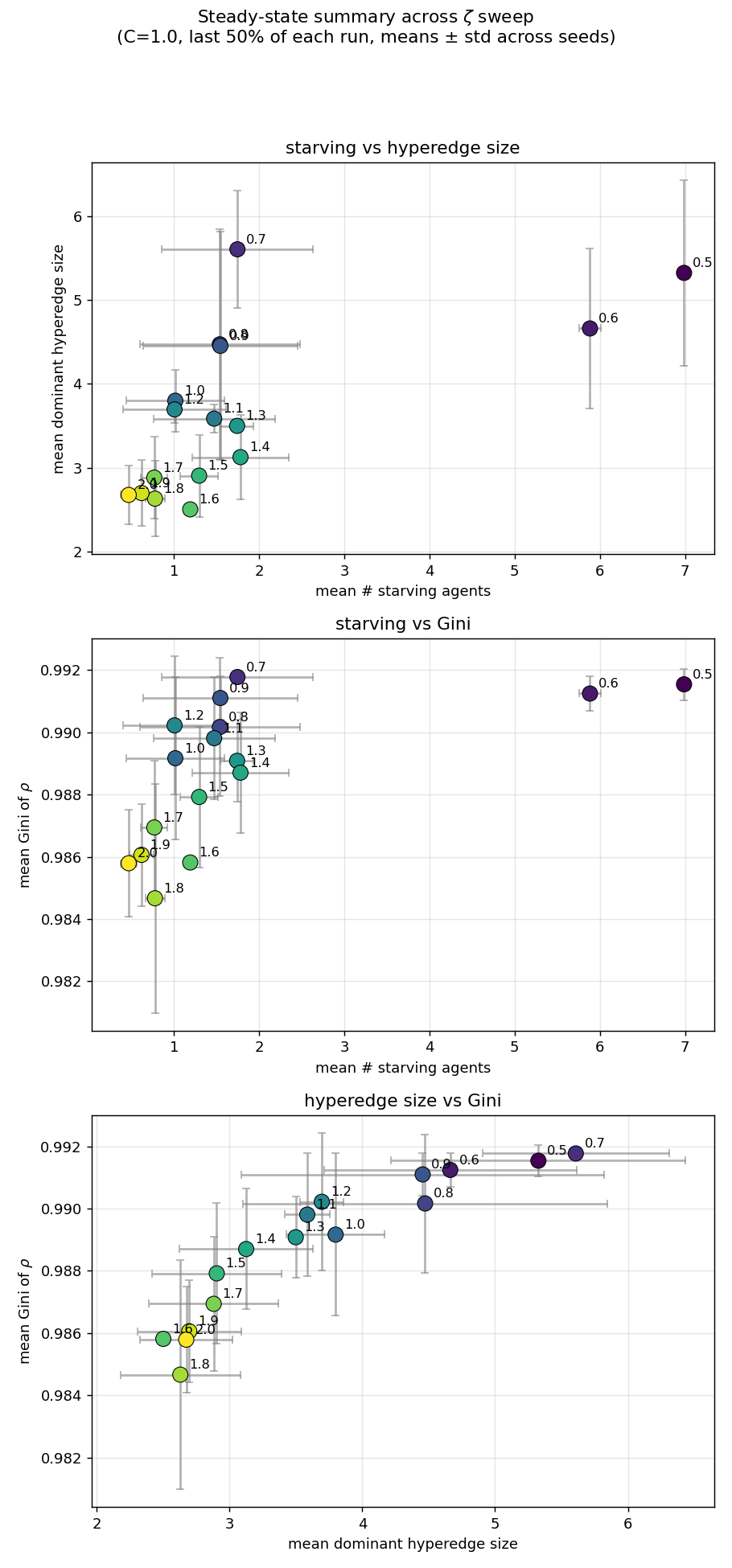
When we look at the hypergraph visualization over time what immediately jumps out is the dominance of dyadic social groups in highly affluent configurations , with
Something amazing is the

Future Work & Conclusion
What comes next is two fold:
- Failure State, i.e. opinion resets with resource inheritance
- Resource Variety and Foraging Tradeoffs
I'm not 100% sure how this will work though I assume it should be simple. We'll see.
I'm going to take the foraging mechanics from a textbook I bought a while back in grad-school by Robert L. Bettinger at U.C. Davis, Hunter-Gatherer Foraging: Five Simple Models.
If you can't tell yet, this project has been brewing in my mind for years up until now, when I finally feel as if I know enough to take a shot at it. This project began in the summer of 2021 when I spent my time going to the library at Montana State University, reading as many books as I could get my hands on. This is where I first discovered Stone Age Economics and where my interest in economic anthropology began. Since this time I have dabbled in enough different fields, especially sociophysics and econophysics, to get a good idea of how to approach the problem of a society-level ancestor simulation.
I'm feeling quite a bit of motivation to see this project through, so I'll keep working at it. If you made it this far, thanks for reading and I'll see you next time!
Discuss