Insider Brief
- Ouster unveiled its Rev8 family of digital lidar sensors, introducing what the company says is the world’s first native-color lidar platform for robotics, autonomous vehicles and industrial AI systems.
- The Rev8 platform is powered by Ouster’s new L4 Silicon architecture, which the company said doubles the range and resolution of its prior generation sensors while processing up to 10.4 million points per second with integrated color and depth perception.
- Ouster said organizations planning to adopt the Rev8 platform include Google, Volvo Autonomous Solutions, Skydio, Field AI and Seegrid.
Ouster unveiled a new generation of digital lidar sensors aimed at robotics, autonomous vehicles and industrial AI systems, introducing what the company says is the world’s first native color lidar platform.
The company announced its Rev8 family of OS lidar sensors, powered by a new L4 Ouster Silicon architecture designed to improve range, resolution and perception capabilities while supporting large-scale deployment across robotics, automotive and smart infrastructure markets. Ouster said the sensors are available for order now and will begin shipping this quarter.
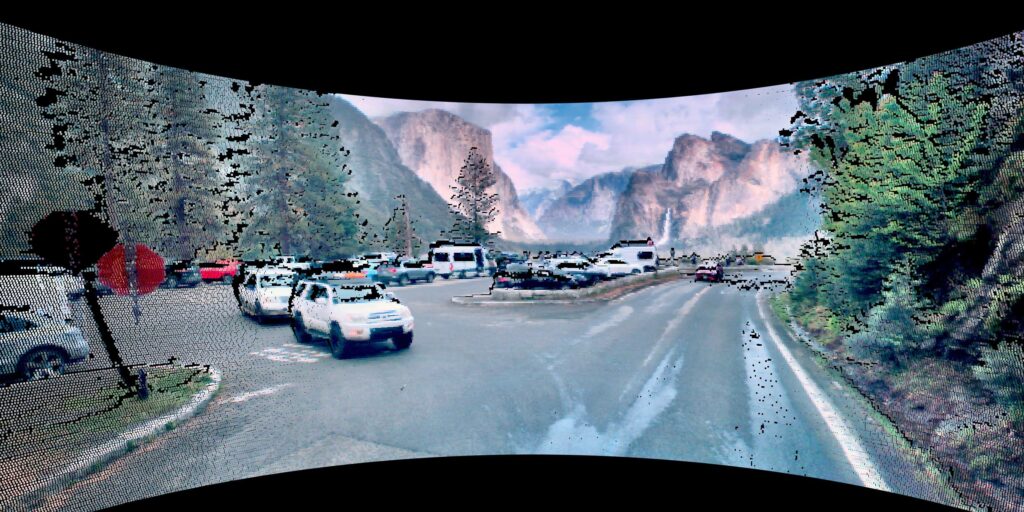
Lidar sensors help machines “see” the world by using lasers to measure the distance, shape and movement of objects around them in 3D. Ouster said its new sensors also add color information directly into that 3D view, allowing robots, vehicles and AI systems to better recognize things like road signs, obstacles, people and equipment without relying as heavily on separate cameras.
“Rev8 is the most advanced family of lidar sensors ever released and sets a new standard in sensing,” CEO Angus Pacala noted. “With the L4 Ouster Silicon, we are delivering on the promise of our digital architecture to deliver exponential improvements in performance, doubling our core specs and simultaneously introducing the world’s first native color lidar to give machines 3D human-like sight for the next era of Physical AI. Rev8 is the foundational technology that will allow customers to move from prototype to commercial production at scale, providing the reliability and affordability required to enable real-world autonomy across industries.”
The Rev8 platform adds native-color sensing directly within the lidar system rather than relying on separate camera-based sensor fusion. According to the company, the approach allows machines to combine depth perception and color information in a single sensor, potentially improving object recognition, mapping and autonomous decision-making while reducing calibration complexity.
The new L4 architecture doubles the range and resolution of its previous generation lidar sensors and processes up to 10.4 million points per second, according to the company. The system also incorporates embedded Fujifilm color science and hardware-enabled high dynamic range capabilities intended to maintain performance across extreme lighting conditions.
The flagship OS1 Max sensor is designed for long-range autonomy applications including industrial robotics, mining equipment, autonomous vehicles and smart infrastructure systems. Ouster said the sensor can detect objects up to 200 meters away at low reflectivity and has a maximum detection range of 500 meters.
The Rev8 family was engineered for automotive-grade reliability and functional safety standards while also targeting lower-cost, high-volume manufacturing to support broader commercial adoption of lidar systems. Ouster said the sensors are designed for a planned 10-year production life cycle.
The company said organizations planning to adopt the Rev8 platform include Google, Volvo Autonomous Solutions, Skydio, Field AI and Seegrid, among others.