LLMs didn’t become magical overnight — one breakthrough called transformers quietly rewired how machines understand language.
Over the past few years, Large Language Models (LLMs) like ChatGPT, Claude, and Gemini have redefined how humans interact with machines. Whether it’s writing code, summarizing research, or chatting naturally, these models rely on one central breakthrough — the transformer architecture.
But to really appreciate why transformers changed everything, we need to peel back a few layers: what an LLM is, how it processes language, and what makes it so powerful.
Understanding LLMs: More Than Just “Big Models”
An LLM (Large Language Model) is a type of neural network trained to understand and generate human-like text. It takes a sequence of words (or tokens) as input and predicts the next token in the sequence — over and over again.
An LLM is a neural network trained to model the probability of the next token — which lets it generate coherent language, that learns relationships between words, ideas, and contexts by processing huge amounts of text from the internet, books, and codebases.
You can think of an LLM as:
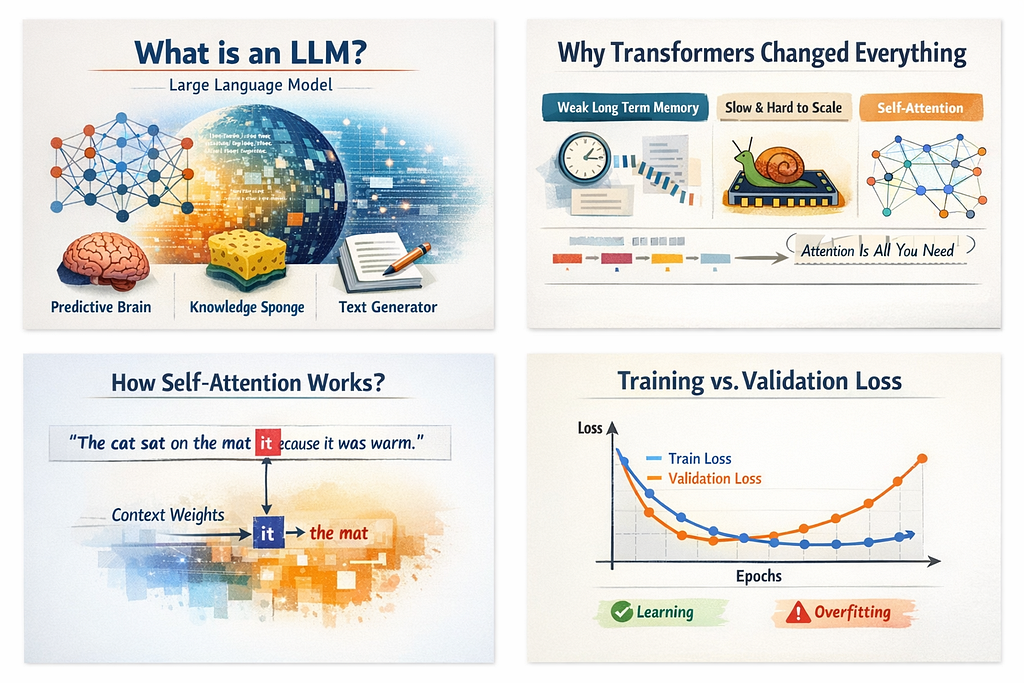
- A predictive brain — trained to guess the next word based on context
- A knowledge sponge — implicitly encoding facts, grammar, and reasoning patterns
- A text generator — sampling next-word probabilities to produce coherent output
But even early models like RNNs and LSTMs could do this — just not very well. The real revolution came with transformers.
Why Transformers Changed Everything
Before transformers, language models faced two major limitations:
1. Weak Long-Term Memory
RNNs process words one at a time, which makes it hard to remember information from far back in a sentence or paragraph.
2. Slow & Hard to Scale
Because processing was sequential, you couldn’t easily parallelize training — making large-scale models impractical.
Then came the 2017 paper “Attention Is All You Need” — introducing the transformer and the concept of self-attention.
Self-attention allows every word to directly “look at” every other word in the sequence, regardless of position. And it does this in parallel, unlike RNNs — which must read tokens one-by-one.
Key Breakthroughs
✔ Parallelization — entire sequences processed at once → huge speedups
✔ Better Context Understanding — attention weights show which words matter most
✔ Scalability — performance improves consistently with more data + parameters
Simply put:
Transformers made it practical to train really big language models — unlocking GPT, PaLM, LLaMA, and beyond.
Intuition: How Self-Attention “Thinks”
Consider the sentence:
“The cat sat on the mat because it was warm.”
When the model processes “it,” self-attention helps determine that “it” refers to “the mat,” not the cat — based on contextual weights.
Each transformer layer refines this understanding further.
Deeper layers learn higher-level concepts — from grammar → meaning → reasoning → code logic.
This is the foundation of LLM capability.
🧩 Code: Tokenization Demo
Before an LLM can process text, it must tokenize it — splitting words into smaller units the model understands.
“Tokenizers split text into subwords so the model has a manageable vocabulary.”
Here’s a simple demo using Hugging Face:
from transformers import AutoTokenizer
# Load a tokenizer (e.g., GPT-2)
tokenizer = AutoTokenizer.from_pretrained("gpt2")
# Input text
text = "Transformers changed everything in AI."
# Tokenize the text
tokens = tokenizer.tokenize(text)
token_ids = tokenizer.convert_tokens_to_ids(tokens)
print("Tokens:", tokens)
print("Token IDs:", token_ids)
print("Decoded back:", tokenizer.decode(token_ids))
What’s happening?
- Text is split into subword units like "Transform", "ers"
- Each token maps to a numeric ID
- The model converts IDs into vectors and feeds them into transformer layers
This is the first step in every LLM pipeline.
Code: Train vs Validation Curve
Training deep models means watching for overfitting — when performance improves on training data but worsens on unseen data.
Here’s a simple visualization:
import matplotlib.pyplot as plt
epochs = list(range(1, 11))
train_loss = [1.2, 0.95, 0.8, 0.65, 0.55, 0.48, 0.44, 0.41, 0.39, 0.38]
val_loss   = [1.25, 1.0, 0.88, 0.8, 0.78, 0.82, 0.88, 0.95, 1.05, 1.18]
plt.plot(epochs, train_loss, label="Train Loss")
plt.plot(epochs, val_loss, label="Validation Loss")
plt.xlabel("Epochs")
plt.ylabel("Loss")
plt.title("Train vs Validation Loss")
plt.legend()
plt.show()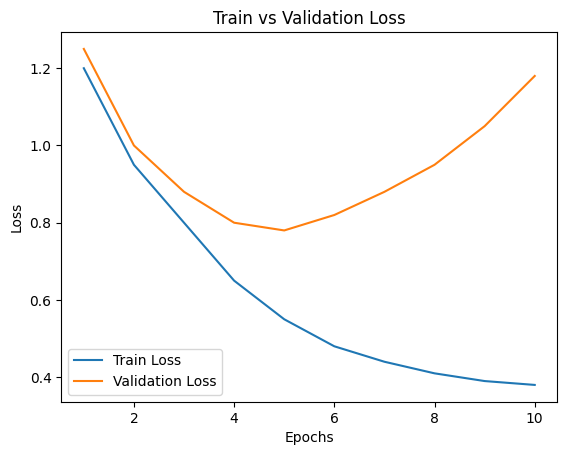
How to read this
- Training loss keeps decreasing → model is learning
- Validation loss decreases, then rises → model begins overfitting
This is why we use techniques like early stopping, dropout, and regularization.
Real-World Impact
Transformers didn’t just boost accuracy — they reshaped AI development.
In NLP
Models like GPT, BERT, and T5 made transfer learning standard practice.
Beyond Text
Transformers now power:
- Vision Transformers (ViT)
- Audio models
- Protein folding models
- Multimodal AI
In Production
They enable:
- scalable inference :making model predictions efficiently and reliably at large scale.
- fine-tuning
- context-aware systems : is any system that senses and uses contextual information (like location, time, user activity, environment, history, intent, etc.) to adapt its behavior automatically
- chatbots
- copilots
- RAG pipelines
Transformers are now the backbone of modern AI systems.
Final Thoughts
- LLMs = transformer-based models trained on massive text corpora
- Transformers succeeded because they scale efficiently
- Self-attention enables deep contextual understanding
- Scaling unlocked emergent abilities like reasoning & coding
If you understand tokens, attention, and scaling —
you understand the heart of modern AI.
— — — If you enjoyed this, follow me for more AI explainers 🙂 — — —
What is an LLM and Why Transformers Changed Everything was originally published in Towards AI on Medium, where people are continuing the conversation by highlighting and responding to this story.