Stop forcing language models to do math in their heads. Architecting deterministic compute for advanced enterprise analytics.
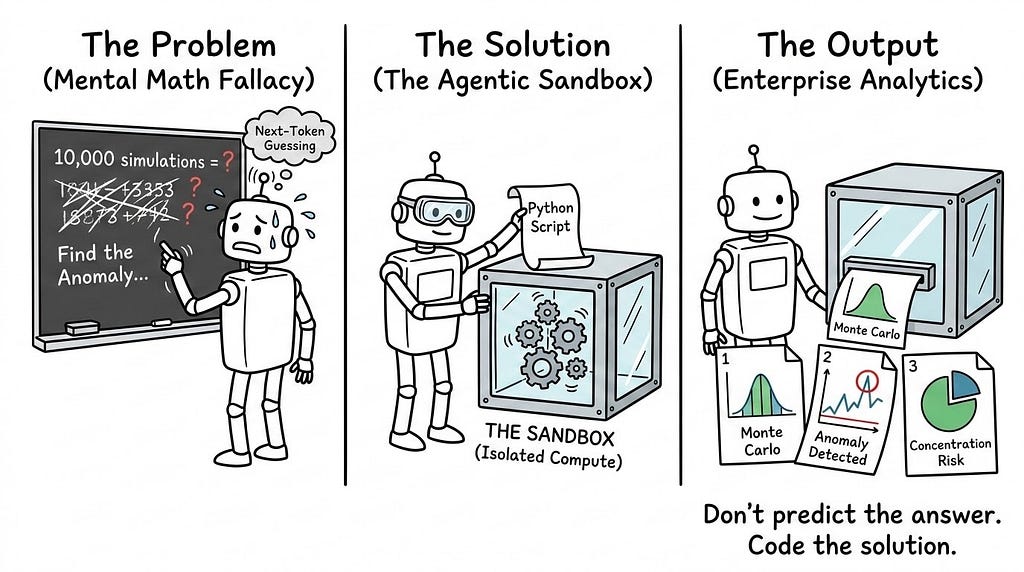
The “Mental Math” Fallacy (The Problem)
In our previous article, we solved the problem of memory by giving our agent a Session Cache. Now, we must solve the problem of compute.
When an enterprise first deploys an AI agent, there is often a honeymoon phase. A user asks the agent, “What is 2,450 plus 1,320?” and the agent instantly replies, “3,770.” The user is thrilled. The assumption is made that because the LLM can converse fluently, it must also possess a hidden, internal calculator.
This assumption is an enterprise disaster waiting to happen.
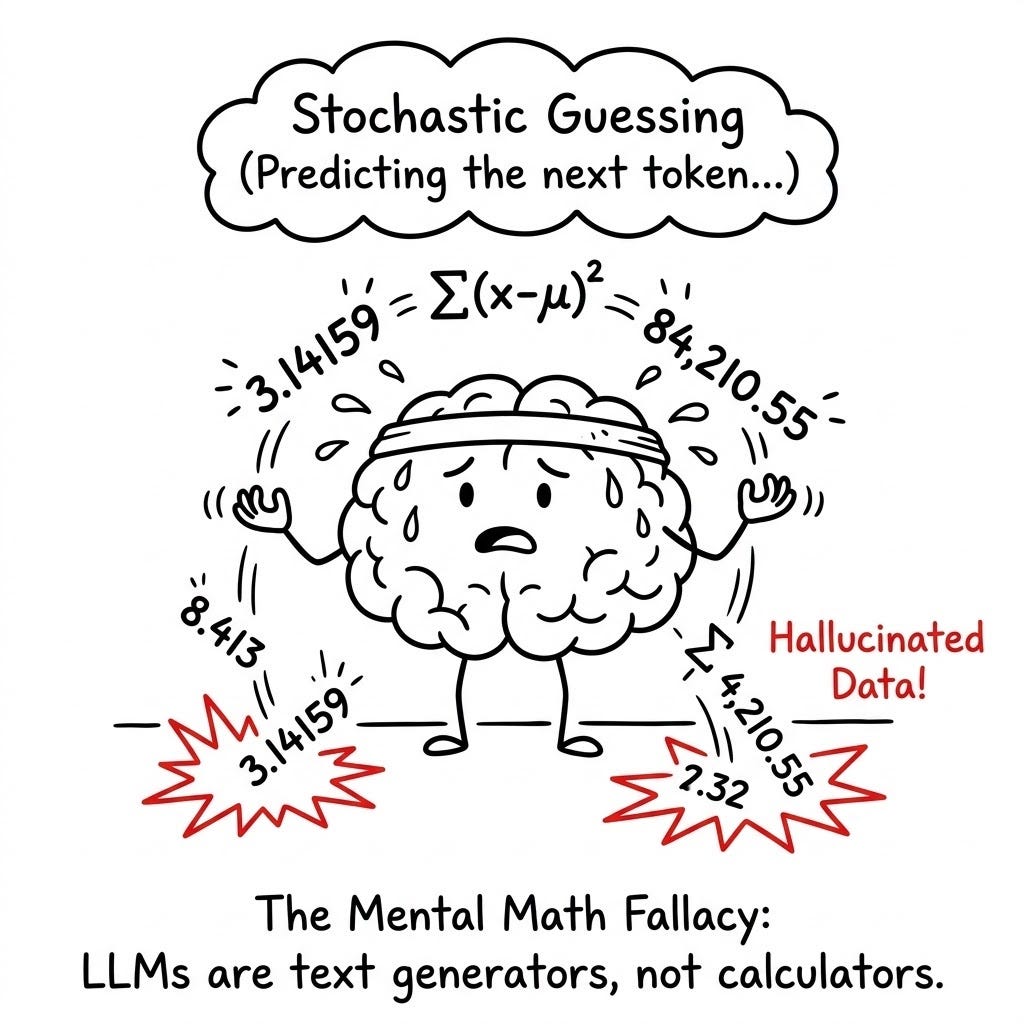
Large Language Models do not do math. They do not parse CSV files. They do not run algorithms. They are autoregressive, stochastic pattern-matchers. When you ask an LLM to multiply two large numbers, it is not moving variables into an Arithmetic Logic Unit (ALU) like a CPU does. It is simply guessing the most statistically probable next token based on its training data.
In computer science, relying on a text generator to do math is called Stochastic Guessing. I refer to it as the “Mental Math” Fallacy.
The Catastrophic Edge Case
If you ask an agent a highly common math question, it might get it right because it memorized the string of text during training. But what happens when the CEO asks the agent to look at a 5,000-row CRM export and says: “Calculate the Q3 revenue growth, find the median deal size, and identify any anomalous churn clusters.”
A naive agent will attempt to do all of this in its “head.” It will read the JSON payload, try to juggle thousands of floating-point numbers in its neural network, and confidently generate a beautifully formatted markdown table of results.
And those results will be entirely hallucinated.
In a sandbox environment, an LLM getting a math problem wrong is a funny screenshot on Twitter. In an enterprise environment, a hallucinated median deal size or a botched revenue calculation can trigger catastrophic business decisions. We demand 100% deterministic accuracy for analytics, but we are using a tool engineered for 80% probabilistic creativity.
If a human data scientist needs to find an anomaly in a dataset, they don’t stare at the numbers until the answer comes to them in a vision. They open a terminal and write a script. We must architect our agents to do the exact same thing.
Offloading Compute (The Solution)
To solve the Mental Math Fallacy, we must once again look at human enterprise workflows. If a CFO asks a financial analyst to find the correlation between marketing spend and customer acquisition cost across fifty states, the analyst does not stare at the ceiling, close their eyes, and attempt to visualize the answer.
They open up a tool. They use Excel, or they open a Jupyter Notebook, write a Python script, execute it, and read the output.
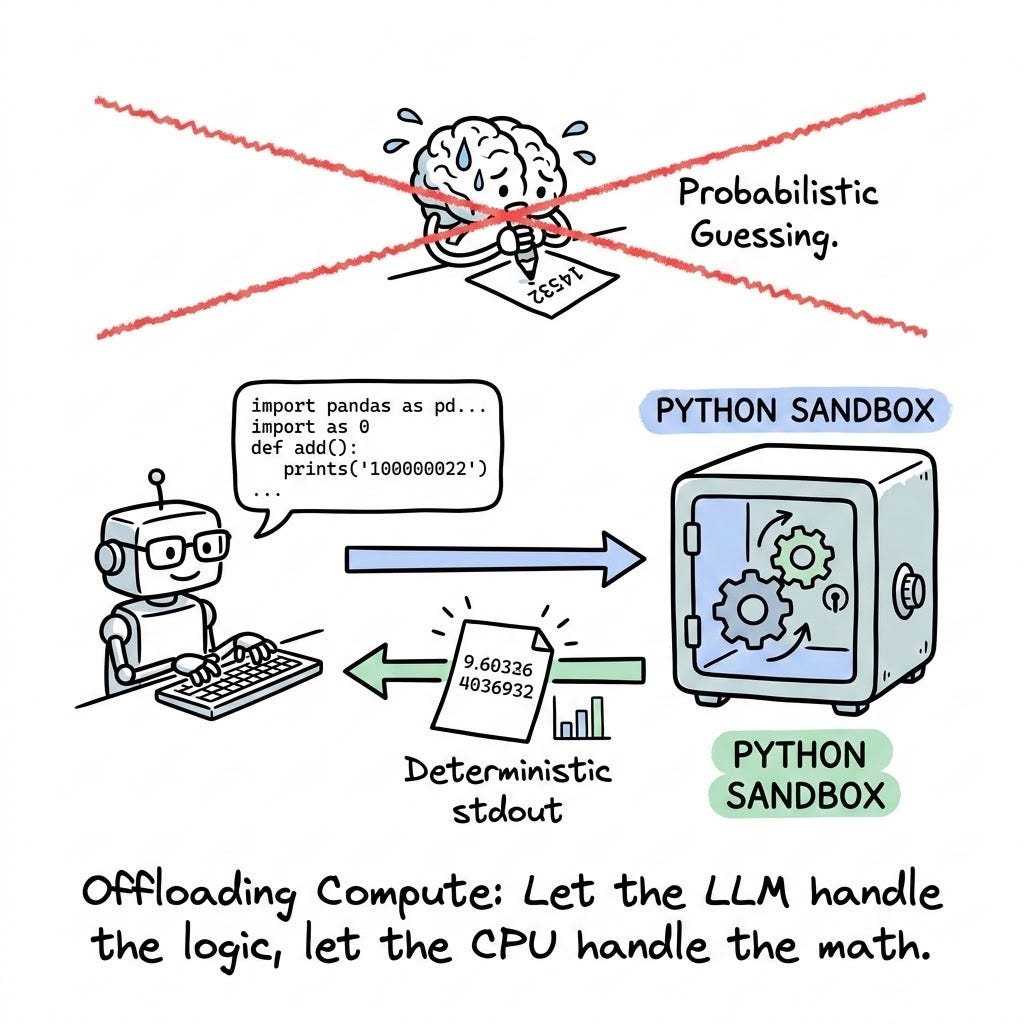
We must architect our agents to do the exact same thing. Instead of asking the language model to be the calculator, we must teach it to use the calculator. This is achieved by introducing a secure, isolated runtime environment — the Agentic Sandbox — and exposing it via a specific tool: execute_python.
The Deterministic Workflow
When you grant an agent access to a Python interpreter, you fundamentally change its cognitive process. The workflow shifts from probabilistic generation to deterministic execution:
- The Prompt: The user asks a complex analytical question: “Run a Monte Carlo simulation on our current burn rate to project Q4 runway.”
- The Code Generation (The Agent’s Job): The agent does not try to predict the final dollar amount. Instead, using its mastery of syntax, it writes a fully functional Python script utilizing libraries like numpy and pandas.
- The Tool Call: The agent calls the execute_python(code_string) tool, passing its newly minted script as the payload.
- The Sandbox Execution (The Machine’s Job): A secure, containerized Python environment receives the script, executes the math deterministically, and captures the standard output (stdout).
- The Context Return: The exact, mathematically flawless result (e.g., “Simulation complete. 95% confidence interval shows Q4 runway between $2.1M and $2.4M”) is injected back into the LLM’s context window.
The Architectural Shift
By offloading the compute layer to an external interpreter, we bridge the gap between language and logic. The LLM handles the intent and the reasoning (writing the code), while the traditional CPU handles the arithmetic (running the code).
This is how you achieve 100% deterministic accuracy for advanced data science tasks like anomaly detection, revenue concentration risk, and statistical forecasting. You stop asking the model to predict the answer, and you start asking it to build the solution.
The Code Artifact: The Secure Python Sandbox
We have the theory and the architectural mandate. Now, we must build the infrastructure.
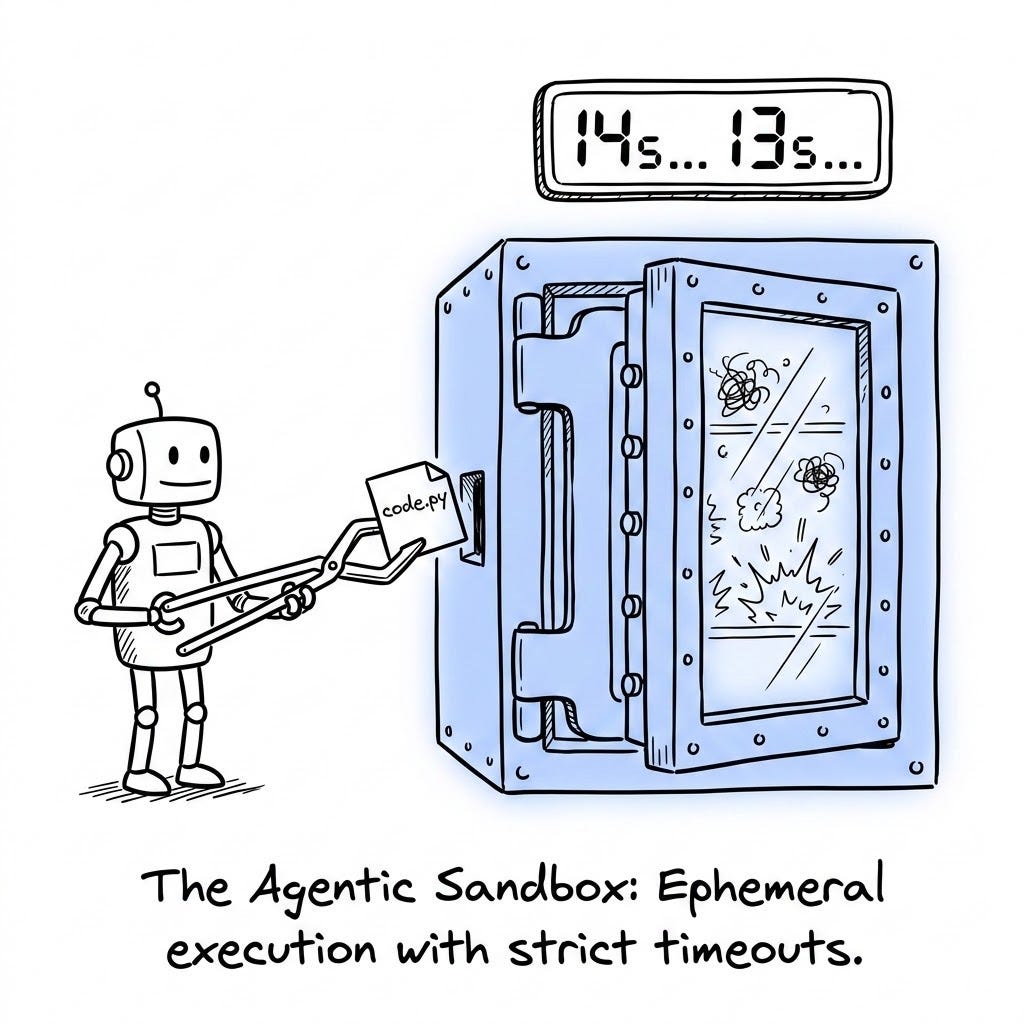
Executing LLM-generated code in a production environment introduces a massive security risk. You absolutely cannot just pass the output of an agent directly into Python’s native exec() or eval() functions on your host server. If the agent hallucinates an infinite loop, it will crash your application. If it gets malicious (or is subjected to prompt injection), it could wipe your environment variables.
In a true enterprise deployment, this execution happens in a tightly controlled container (like an ephemeral Docker instance or Kubernetes pod). However, to understand the core logic, below is a Python implementation of a SubprocessSandbox.
This class writes the agent’s code to a temporary file, executes it in an isolated subprocess, enforces a strict timeout to prevent infinite loops, and captures the standard output to send back to the context window.
import subprocess
import tempfile
import os
from typing import Dict, Any

class SecurePythonSandbox:
    """
    A runtime executor that isolates LLM-generated code.
    Enforces timeouts and returns stdout/stderr deterministically.
    """
    def __init__(self, timeout_seconds: int = 15):
        self.timeout_seconds = timeout_seconds

    def execute_python(self, code_string: str) -> str:
        """
        Tool exposed to the Agent.
        Takes a raw Python script, runs it securely, and returns the result.
        """
        # 1. We write the agent's code to a temporary, isolated file
        with tempfile.NamedTemporaryFile(mode='w', suffix='.py', delete=False) as temp_script:
            temp_script.write(code_string)
            script_path = temp_script.name

        try:
            # 2. Execute the script in a separate process
            # We restrict network access and file system permissions at the OS level here
            result = subprocess.run(
                ['python3', script_path],
                capture_output=True,
                text=True,
                timeout=self.timeout_seconds
            )

            # 3. Handle the deterministic output
            if result.returncode == 0:
                # Success: Send the standard output back to the LLM
                return f"EXECUTION SUCCESS:\n{result.stdout}"
            else:
                # Error: Send the traceback to the LLM so it can self-correct!
                return f"EXECUTION FAILED:\n{result.stderr}"

        except subprocess.TimeoutExpired:
            return f"ERROR: Script execution exceeded the {self.timeout_seconds}-second timeout. Did you write an infinite loop?"
        except Exception as e:
            return f"SYSTEM ERROR: {str(e)}"
        finally:
            # 4. Clean up the ephemeral environment
            if os.path.exists(script_path):
                os.remove(script_path)
The Outcome
By equipping your agent with this SecurePythonSandbox, you fundamentally elevate its utility.
When asked to calculate a Monte Carlo simulation for next quarter’s revenue trajectory, the agent will write the numpy script, pass it to execute_python, and wait. The Sandbox spins up, crunches the numbers in 1.2 seconds, and returns a mathematically perfect string. The model then wraps that deterministic answer in a natural language response for the user.
You have successfully decoupled logic formulation from arithmetic computation. You have engineered a system that does not guess the answer, but mathematically proves it.
Build the Complete System
This article is part of the Cognitive Agent Architecture series. We are walking through the engineering required to move from a basic chatbot to a secure, deterministic Enterprise Consultant.
To see the full roadmap — including Semantic Graphs (The Brain), Gap Analysis (The Conscience), and Sub-Agent Ecosystems (The Organization) — check out the Master Index below:
The Cognitive Agent Architecture: From Chatbot to Enterprise Consultant
The Agentic Sandbox: Why Your LLM Needs a Python Interpreter was originally published in Towards AI on Medium, where people are continuing the conversation by highlighting and responding to this story.