Stability Over Disruption — The Economic Balance Rule(AI SAFE© 2)
by Michal Florek, September 2025 (Updated April 2026)
Executive Summary
Artificial Intelligence is reshaping global economies at a velocity unmatched by any previous technological wave. While its potential for productivity gains, cost savings, and innovation is undeniable, its unchecked deployment risks destabilizing the very economic systems that underpin modern societies.
The AI SAFE© 2 Framework — The Economic Balance Rule asserts a guiding principle: AI must prioritise stability over disruption.
History demonstrates that technological revolutions often create winners and losers, but the pace and scale of AI adoption threaten to amplify systemic risks. Mass job displacement could outpace adaptation, algorithmic finance already shows signs of fragility, and inequality may deepen if guardrails remain absent.
The Economic Balance Rule ensures that progress is sustainable, inclusive, and stabilising. By embedding impact assessments, stress testing, and transition planning, AI SAFE© 2 protects societies from cascading disruptions while preserving the benefits of innovation.
Introduction
AI is not only a technological revolution but also an economic stress test. Unlike steam engines or assembly lines, AI ripples across sectors in months, not decades. The challenge is not whether AI should advance, but how it advances.
Past crises offer lessons: the Industrial Revolution displaced generations of workers before labour laws caught up; the dot-com bubble destabilized markets; the 2008 financial crisis exposed the dangers of innovation outpacing oversight. AI risks repeating these cycles — only faster.
The Economic Balance Rule (AI SAFE© 2) responds by requiring AI deployment at a pace that economies can absorb. Stability-First governance ensures disruption compounds into prosperity, rather than fragility.
The Economic Balance Rule (Definition & Principle)
The Economic Balance Rule requires that Artificial Intelligence be introduced in ways that preserve macroeconomic resilience, ensuring innovation compounds over time rather than collapsing under the weight of its own disruption.
Core Principles:
- Stability Before Acceleration
- Economic Adequacy Requirements
- Transition as Infrastructure
- Shared Prosperity as Stability Anchor
- Auditability for Measurement & Fairness — not just for Value Creation
Without this rule, AI adoption risks accelerating inequality, volatility, and fragility — repeating the mistakes of unregulated finance and hyper-globalization.
By embedding Stability-First design, we shift the narrative from “Can AI disrupt faster?” to “Can AI sustain prosperity longer?”. That is the true measure of progress.
Challenges & Gaps in AI roll outs
Economic Risks
- Challenge: Rapid displacement of labour across logistics, retail, finance, and professional services. AI systems scale faster than traditional reskilling mechanisms.
- Gap: No standardised process to assess labour market shock prior to AI deployment. Governments often react after disruption rather than prepare for it.
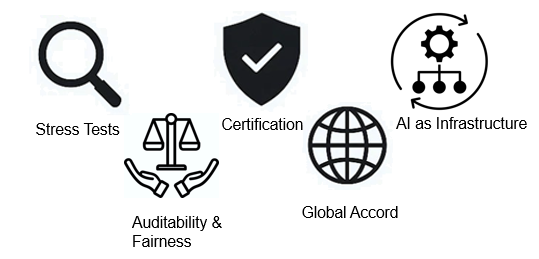
- Opportunity: Introduce AI Economic Stress Tests — modelled on banking stress tests — to forecast sectoral disruption, unemployment shocks, and fiscal impact before rollout.
Policy & Regulation
- Challenge: Current AI regulation is narrowly focused on ethics, privacy, risk and safety — with little to no attention on macroeconomic stability.
- Gap: Absence of international coordination. No equivalent to the Basel Accords or IMF-style oversight for AI’s economic footprint.
- Opportunity: Develop a Global AI Economic Stability Accord that sets minimum standards for economic adequacy requirements, transition planning, and distributional safeguards.
Corporate Incentives
- Challenge: Firms optimize for shareholder value and speed-to-market, often externalizing disruption costs to workers, communities, and governments.
- Gap: Lack of obligation for companies to internalize economic transition costs (e.g., retraining, social safety nets).
- Opportunity: Establish AI Stability Certification that ties incentives (tax breaks, access to public contracts, reputational capital) to firms that demonstrate measured deployment and transition planning.
Capital Markets & Financial Systems
- Challenge: Algorithmic decision-making can exacerbate volatility in trading, lending, and insurance. Flash crashes and credit discrimination are early warning signals.
- Gap: Financial regulators do not yet have frameworks to audit AI models for systemic market risk.
- Opportunity: Mandate AI Model Auditability for financial AI systems, akin to stress-testing liquidity in banks, ensuring they cannot trigger destabilizing cascades.
Societal Impacts
- Challenge: Wealth concentration and hollowing-out of the middle class undermine aggregate demand and social cohesion.
- Gap: Governments lack redistributive levers tied specifically to AI-driven value creation. Taxation regimes lag behind platform-scale AI economics.
- Opportunity: Pilot AI Dividend Mechanisms — fiscal instruments where portions of AI-driven productivity gains are recycled into reskilling funds, universal transition support, or regional revitalization programs.
Measurement & Foresight
- Challenge: Policymakers and firms lack predictive tools for anticipating AI’s ripple effects across sectors and geographies.
- Gap: No shared metrics exist for tracking “economic stability impact” of AI adoption. Current KPIs privilege innovation speed and cost savings.
- Opportunity: Create a Stability Index for AI Deployment that measures impact on employment, market volatility, tax revenue resilience, and inequality.
In short, the challenge is not AI itself, but the absence of systemic foresight and stabilising mechanisms. AI SAFE© 2 reframes AI deployment as an economic design problem, not just a technological one.
Roadmap to Implementation
Stability requires sequencing: short-term interventions buy time, medium-term frameworks embed governance, and long-term reforms create generational resilience.
Short-Term Priorities (1–2 years)
Stabilizers for Immediate Risk Management
- AI Economic Stress Tests → Pilot national-level assessments for high-impact AI deployments (logistics, finance, healthcare).
- AI Model Auditability in Finance → Require regulators to audit trading/lending AI for systemic risk (prevent flash-crash scenarios).
- Baseline Metrics & Stability Index → Develop shared indicators to measure AI’s effect on employment, volatility, and inequality.
- AI Stability Certification (Pilot Phase of AISAFE©) → Voluntary scheme for firms that demonstrate transition planning & measured deployment.
Medium-Term Priorities (3–5 years)
Embedding Stability into Governance & Market Incentives
- Global AI Economic Stability Accord → International framework (akin to Basel Accords) setting minimum “economic adequacy” requirements.
- Mandatory AI Economic Impact Assessments → Legally required before mass rollout of systems affecting >100,000 jobs or $10bn market value.
- Corporate Transition Obligations → Firms must co-fund retraining and regional adjustment when introducing disruptive AI.
- AI Dividend Mechanisms (Pilot) → Governments recycle part of AI-driven productivity gains into re-skilling funds and universal transition support.
Long-Term Priorities (6–10 years)
Structural Adaptation for Generational Resilience
- Integration of Transition Infrastructure → Reskilling, safety nets, and fiscal adaptation treated as embedded infrastructure (like utilities).
- Full Stability Certification System → AI Stability Certification (AISAFE© proposed) becomes a global norm, tied to trade access, tax incentives, and public procurement.
- AI Dividend Mechanisms (Scaled) → Formal fiscal structures ensuring broad distribution of AI’s economic gains, preserving aggregate demand.
- Resilience-Weighted Growth Models → Shift from GDP and efficiency-only measures to models that value resilience, equity, and stability as indicators of progress.
Case Studies
Case Study 1: The 2010 Flash Crash — When Algorithms Outran Oversight
On May 6, 2010, U.S. equity markets experienced one of the sharpest intraday collapses in modern financial history. In less than 30 minutes, the Dow Jones Industrial Average plunged nearly 1,000 points — wiping out almost $1 trillion in market value — before rebounding almost as quickly. The cause: a cascade of interactions between high-frequency trading algorithms, each executing at speeds beyond human oversight.
What looked like a technical anomaly was, in fact, a structural warning. Financial markets had already adopted algorithmic trading at scale, but regulators had not yet equipped themselves with tools to model or stress-test the systemic interactions of these algorithms. Each firm optimized for speed and advantage, but collectively the system behaved like a stampede — fragile, volatile, and capable of collapsing investor confidence in seconds.
Statistics
- Dow Jones lost ~9% in minutes, fastest drop in modern trading history.
- ~$1 trillion market value erased temporarily.
- Triggered by a single $4.1B futures order, amplified by HFT algorithms.
- Recovery only partial; investor trust suffered long-term damage.
Investor confidence was shaken, highlighting fragility of algorithm-driven markets. This event has showed that without systemic stress testing, AI-driven systems can destabilize entire markets in minutes.
Key Lessons for AI SAFE© 2:
Disruption Without Guardrails = Fragility
- Speed and efficiency gains at the micro level created catastrophic instability at the macro level.
Stress Testing as Prevention
- Just as banks now undergo stress tests, AI trading algorithms should have been stress-tested against cascading interactions.
Macro vs. Micro Incentives
- Individual firms optimized for advantage, but no entity took responsibility for collective stability — a gap AI SAFE© 2 explicitly seeks to close.
If financial markets — some of the most heavily regulated domains in the world — could be destabilized so quickly by untested AI systems, what happens when similar dynamics ripple through logistics, healthcare, or energy?
The Flash Crash was not an isolated glitch. It was an early preview of how AI can amplify systemic risks if deployed without stability-first oversight. It is precisely why AI SAFE© 2 — The Economic Balance Rule is essential.
Case Study 2: Self-Driving Trucks & Labour Market Shock — When Automation Collides with Employment at Scale
The trucking industry is one of the largest sources of employment in North America and Europe. In the U.S. alone, nearly 3.5 million drivers are employed directly, with an additional 6 million jobs tied to supporting services such as maintenance, fuel, and logistics coordination.
The proposed introduction of self-driving trucks — AMERICA DRIVES Act (2025/26) — promises efficiency: reduced fuel costs, fewer accidents, and 24/7 operations. But these gains conceal a systemic risk. If adoption occurs too rapidly — driven by competitive pressure rather than measured transition — the displacement shock could ripple across entire regional economies, eroding employment, tax bases, and consumer demand.
Statistics
- Trucking employs ~3.5M drivers in the U.S., ~2.5M in Europe.
- Sector generates $700+ billion annually in U.S. freight revenues.
- Rapid adoption could displace up to 40% of drivers within a decade.
- Tax base and local economies disproportionately reliant on trucking regions.
The question isn’t whether self-driving trucks will arrive, but whether economies can phase adoption responsibly to preserve stability.
Key Lessons for AI SAFE© 2
Adoption Velocity Matters
- Efficiency gains become destabilizing if deployment outruns adaptation capacity.
Transition as Infrastructure
- Reskilling and safety nets must be built in before automation scales.
Regional Fragility
- Concentrated industries amplify risk: disruption in trucking-heavy states translates into localized economic collapse.
Stability Over Speed
- AI SAFE© 2 reframes automation not as a race to efficiency, but as a phased integration into economic systems.
Unlike previous technological shifts that unfolded over decades, autonomous trucking could scale within 5–7 years once technical and regulatory barriers fall. This means millions of middle-income jobs could vanish faster than retraining infrastructure, safety nets, or fiscal systems can adjust.
Case Study 3: AI-Driven Lending & Credit Scoring Inequality — When Automation Reinforces Fragility Instead of Stability
Credit is the bloodstream of modern economies. Access to loans determines who can buy homes, start businesses, or weather financial shocks. In the last decade, financial institutions have increasingly turned to AI-driven credit scoring models to improve efficiency and reduce default risk.
While these systems promise faster approvals and finer risk calibration, they also embed systemic dangers:
- Bias Amplification
- Opacity & Auditability Gaps
- Systemic Risk
This is not speculative. Studies have shown AI-based credit scoring models disproportionately reject women and minority borrowers despite similar financial profiles.
Statistics
- A 2019 study found AI-driven mortgage algorithms charged minority borrowers 0.08% higher interest rates on average.
- AI-based credit scoring has been shown to deny loans to thin-file applicants (gig workers, freelancers) despite solvency.
- Communities with reduced access to credit face lower entrepreneurship rates and higher foreclosure rates.
At scale, these distortions don’t just harm individuals — they undermine aggregate demand, entrepreneurial dynamism, and social cohesion.
Key Lessons for AI SAFE 2
Fair Access = Stability
- Economies grow when broad groups can access credit; exclusion undermines aggregate demand.
Auditability as Obligation
- Lending AI must be auditable and explainable to ensure stability, not opacity.
Distributional Equity
- Credit inequality at scale is not just a social issue — it is a destabilizer of economic systems.
Stability Over Disruption
- AI must expand economic participation, not shrink it.
The Economic Balance Rule (AI SAFE© 2) reframes these issues: AI in lending must enhance stability by broadening fair access to credit, not restricting it to narrow bands of society. Efficiency without fairness becomes fragility.
Case Study Comparison
The ‘2010 Flash Crash’ case illustrates precisely why AI SAFE© 2 — The Economic Balance Rule is essential. AI systems in finance were deployed for efficiency and profit, but without a stability-first framework they created systemic fragility. Markets functioned not as a stabilizer of economies, but as an amplifier of volatility. The result was not just financial whiplash, but a near-miss for economic trust itself.
The ‘Self-Driving Trucks & Labour Market Shock’ case study shows how AI-induced labour shocks can destabilize regional economies just as algorithmic finance destabilized markets. It makes clear why transition planning must be embedded as infrastructure, not an afterthought.
The ‘AI-Driven Lending & Credit Scoring Inequality’ case study demonstrates how hidden instability emerges not just from market crashes or job loss, but from biased allocation of opportunity. It reinforces that the Economic Balance Rule must operate across both labour markets and financial systems to preserve long-term prosperity.
AI fragility manifests differently across domains — in volatility, displacement, and inequality. But the underlying pattern is the same: disruption without stabilizers creates systemic instability. The Economic Balance Rule aligns these lessons into one framework: stability before acceleration
The Bridging Argument
The three case studies — the 2010 Flash Crash, the looming disruption of self-driving trucks, and the inequities of AI-driven lending — may appear to sit in different domains. One is financial, one is labour-based, one is about social equity. Yet when examined through the lens of systemic foresight, they reveal the same underlying pattern:
- AI systems optimized for speed, efficiency, or profit at the micro level created instability at the macro level.
- The absence of stability-first mechanisms meant disruption cascaded faster than adaptation.
- The costs of disruption were socialized (borne by workers, households, or public trust), while the benefits were privatised.
This repeating structure is precisely what the Economic Balance Rule (AI SAFE© 2) is designed to counter. The responsibility and cost of market wide implementations of AI cannot be carried only by end-consumers. The accountability and its cost must sit with the services and product suppliers.
By reframing AI deployment around stability before acceleration, it transforms isolated “accidents” into predictable — and therefore preventable — outcomes.
Connecting the Case Studies
Flash Crash (Markets) → Fragility through volatility.
- Lesson: AI financial systems must undergo stress testing before deployment, just as banks do.
Self-Driving Trucks (Labour) → Fragility through displacement.
- Lesson: AI adoption must be phased in line with transition infrastructure, not faster.
AI Lending (Credit Access) → Fragility through inequality.
- Lesson: AI financial models must be auditable and fair, ensuring prosperity is distributed rather than concentrated.
Across each domain, the missing element was the same: a stability safeguard. The costs were not technological failures, but governance failures — a lack of foresight in designing adaptation mechanisms alongside innovation.
The Unifying Principle
The bridging insight is this: AI does not destabilize economies because it is powerful, but because it is deployed without synchronization to systemic capacity. When AI’s velocity outpaces adaptation, fragility is inevitable. The Economic Balance Rule (AI SAFE© 2) restores equilibrium by aligning innovation cycles with social, fiscal, and institutional absorption rates.
Why This Matters?
- For governments, the rule provides a framework for anticipating AI-driven shocks before they destabilize tax bases, employment, or financial markets.
- For corporations, it sets incentives for sustainable adoption — balancing innovation with responsibility.
- For societies, it ensures that AI amplifies prosperity across generations, rather than concentrating gains in bursts that hollow out stability.
The bridging argument is clear: Stability-first design is not a luxury — it is the condition of sustainable innovation. Just as financial crises taught us the necessity of capital adequacy, AI requires economic adequacy to prevent systemic breakdown.
Policy Recommendations
Translating the Economic Balance Rule into Action
The Economic Balance Rule requires putting in place practical stabilizers that governments, regulators, and corporations can implement to align innovation velocity with economic absorption capacity. These five recommendations operationalise AI SAFE© 2.
1. Mandatory AI Economic Stress Tests
- Require pre-deployment stress tests for AI systems with systemic impact (finance, logistics, healthcare, energy).
- Simulate ripple effects: employment loss, market volatility, fiscal strain, inequality.
- Publish results for transparency, mirroring banking stress test frameworks.
2. AI Stability Certification (AI SAFE©)
- Certify organizations that meet stability-first standards: phased deployment, transition planning, auditability.
- Only Certified firms gain preferential access to tax incentives, public procurement, and reputational branding.
- Acts as a “trust signal” for consumers, investors, and regulators.
3. Transition to AI as Infrastructure and Infrastructure Regulations
- Require firms introducing disruptive AI to co-fund worker reskilling and safety nets.
- Establish AI Transition Funds financed by an AI productivity levy to support regions most at risk.
- Elevate reskilling platforms and social safety nets to the level of infrastructure — planned and permanent, not ad-hoc policy responses.
4. Independent Economic Impact Assessments
- Large-scale AI deployments (affecting >100,000 jobs or >$10B market value) must undergo independent impact assessments.
- Regulators can delay, phase, or condition deployment if stability risks are identified.
- Functions as an “impact brake” to prevent irreversible harm.
5. Global AI Stability Index
- Create an index to monitor AI’s impact on:
- Employment stability
- Market volatility
- Inequality
- Fiscal resilience
- Governments and corporations update strategies annually against Index findings.
- Over time, becomes a benchmark like GDP or inflation rates — a new macroeconomic compass for AI.
Conclusion
Artificial Intelligence is not just another wave of innovation — it is an amplifier of systemic forces. If left uncoordinated, it will accelerate volatility, concentrate wealth, and erode the very foundations of prosperity. If guided by Stability-Dirst principles, it can instead become the engine of resilient growth across generations.
The three case studies presented — from the sudden volatility of the 2010 Flash Crash, to the looming labour shock of self-driving trucks, to the silent inequities of AI-driven lending — illustrate a single truth: disruption without stabilizers creates fragility. The Economic Balance Rule (AI SAFE© 2) provides the unifying safeguard.
Stability is not a brake on innovation — it is the condition that makes innovation sustainable. Just as aviation, finance, and environmental governance developed safety frameworks to protect society from systemic risks, AI now requires its own: mechanisms that ensure anticipation, stabilization, transition, and adaptation.
The Safety-First Cycle captures this ethos. By embedding foresight, impact brakes, transition infrastructure, and continuous monitoring, we transform AI from a disruptive accelerant into a sustainable multiplier of prosperity. Stability becomes the compounding factor: it ensures that gains are preserved, trust is maintained, and societies remain capable of absorbing change.
The challenge before us is not whether AI will reshape economies — it already is. The challenge is whether we have the foresight and courage to shape AI so that it strengthens, rather than destabilizes, the systems we all depend upon. The Economic Balance Rule is the blueprint for doing so.
References
Academic & Institutional Sources
- Acemoglu, D., & Restrepo, P. (2018). Artificial Intelligence, Automation and Work. National Bureau of Economic Research (NBER Working Paper №24196).
- Brynjolfsson, E., Rock, D., & Syverson, C. (2021). The Productivity J-Curve: How Intangibles Complement General Purpose Technologies. American Economic Journal: Macroeconomics, 13(1), 333–372.
- International Monetary Fund (2023). Generative Artificial Intelligence and the Future of Work. IMF Policy Paper.
- World Economic Forum (2020). The Future of Jobs Report 2020. Geneva: WEF.
- United Nations Development Programme (2023). AI and Economic Stability: Risks, Regulation, and Global Impact. UNDP Technology Briefing Paper.
- OECD (2021). AI Principles in Practice: Policy Lessons for Responsible AI Innovation. Paris: OECD Publishing.
- European Commission (2022). Proposal for a Regulation on Artificial Intelligence (Artificial Intelligence Act). Brussels: COM(2021) 206 Final.
- World Bank (2026). Reskilling Revolution: Preparing 1 billion people for tomorrow’s economy. Washington, D.C.: World Bank Group.
- PubMed Central (2022). Reskilling and Upskilling the Future-ready Workforce for Industry 4.0 and Beyond, Ling Li, National Library of Medicine.
Market & Case Study References
- Kirilenko, A., Kyle, A., Samadi, M., & Tuzun, T. (2017). The Flash Crash: High-Frequency Trading in an Electronic Market. Journal of Finance, 72(3), 967–998.
- U.S. Department of Transportation (2021). Automated Vehicles Comprehensive Plan, Washington, D.C.
- Frey, C. B., & Osborne, M. A. (2017). The Future of Employment: How Susceptible Are Jobs to Computerisation? Technological Forecasting and Social Change, 114, 254–280.
- Garcilazo E., McCann P., (2023). The case for place-based policy: economic divergence, governance integrity and climate change mitigation. Taylor & Francis Online.
- Bartlett, R., Morse, A., Stanton, R., & Wallace, N. (2021). Consumer-Lending Discrimination in the FinTech Era. Journal of Financial Economics, 143(1), 30–51.
- Hurley, M., & Adebayo, J. (2017). Credit Scoring in the Era of Big Data. Yale Journal of Law and Technology, 18(1), 148–216.
- Bank for International Settlements (2021). Financial stability implications of artificial intelligence — Executive Summary.
Economic Stability & Systems Thinking
- Haldane, A. (2016). Speech — The Dappled World. Bank of England Speech Series.
- Taleb, N. N. (2012). Antifragile: Things That Gain from Disorder. U.S., Random House.
- Mazzucato, M. (2018). The Value of Everything: Making and Taking in the Global Economy. London: Allen Lane.
- Stiglitz, J. E. (2019). People, Power, and Profits: Progressive Capitalism for an Age of Discontent. New York: W. W. Norton & Co.
- Florida, R. (2010). How New Ways of Living and Working Drive Post-Crash Prosperity. Harper.
Governance & Safety Frameworks
- Partnership on AI (2023). Guidelines for AI and Shared Prosperity.
- Future of Life Institute (2023). Policymaking in the Pause.
- Harvard Data Science Review (2024). Future Shock: Generative AI and the International AI Policy and Governance Crisis.
- The Alan Turing Institute (2024). U.K. House of Lords Select Committee on Artificial Intelligence Research Publications. The AI Regulatory Capability Framework and Self-Assessment Tool.
- National Institute of Standards and Technology (NIST). (2023). AI Risk Management Framework 1.0. Gaithersburg, MD: U.S. Department of Commerce.
- AI Now Institute (2023). Algorithmic Accountability: Moving Beyond Audits.
- JuLIA Handbook (2021). Julia Project. AI and Public Administration: The (legal) limits of algorithmic governance.
- OECD Legal Instruments (2023). OECD/LEGAL/0498 - Recommendation of the Council on Access to Justice and People-Centred Justice Systems.
- DAI Global (2023). Stankovich M, Behrens E. Burchell J. Toward Meaningful Transparency and Accountability of AI Algorithms in Public Service Delivery.
AI SAFE Initiative Source Material
- Michal Florek — AI SAFE Initiative — https://theailaws.com/ (2025). AI SAFE Framework 1: The Safety-First Rule — Why Efficiency Without Brakes is Dangerous. AI SAFE White Papers, Vol. 1.
- Michal Florek — AI SAFE Initiative — https://theailaws.com/ (2025). AI SAFE Framework 2: The Economic Balance Rule — Stability Over Disruption. AI SAFE White Papers, Vol. 2. Internal draft version 1.2, September 2025.
Stability Over Disruption — The Economic Balance Rule (AI SAFE© 2) was originally published in Towards AI on Medium, where people are continuing the conversation by highlighting and responding to this story.